
What Activepieces is
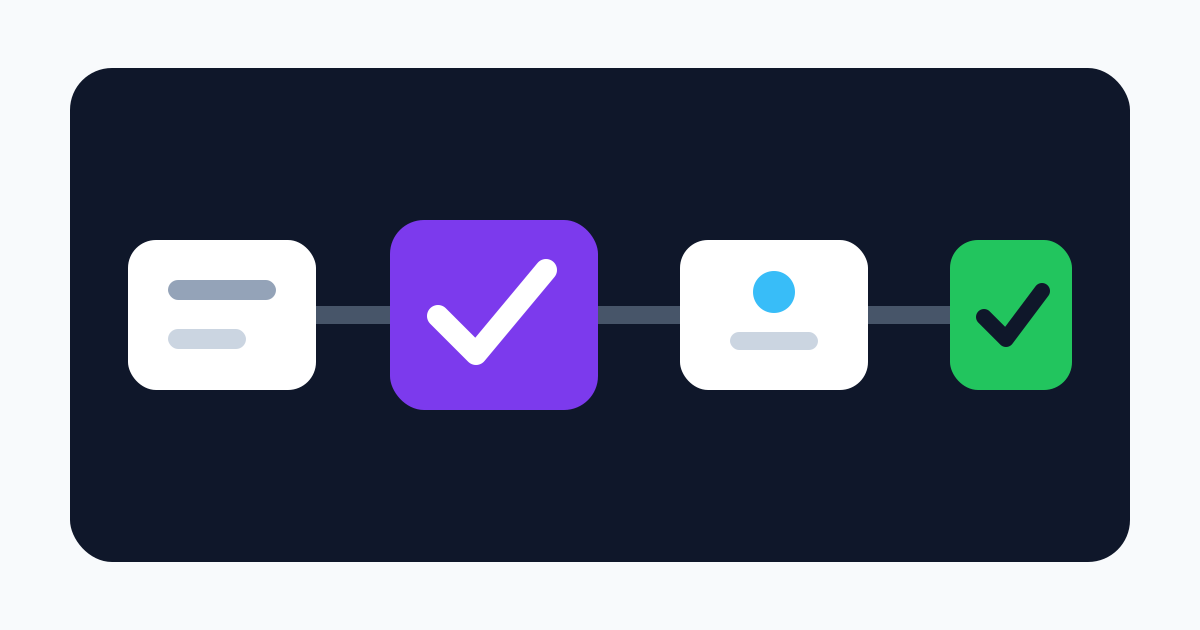
Activepieces is an open-source automation platform for connecting applications, running repeatable workflows, and adding AI agents where a task benefits from model judgment. Its visual builder supports triggers, actions, conditions, loops, code, tables, and integrations called Pieces. The product also exposes MCP capabilities and can pause work for human approval.
The useful distinction is between a flow and an agent. A flow is appropriate when the trigger, business rules, and allowed side effects are known. An agent can choose tools and handle less predictable inputs, but it creates a larger testing and permission surface. A sound implementation usually keeps record updates, notifications, billing actions, and other consequential work inside explicit flow boundaries, using AI for constrained classification, extraction, research, or drafting.
Flows, agents, integrations, and MCP
Activepieces says its ecosystem contains more than 700 integrations. A missing connector is not necessarily a dead end: an HTTP Piece or webhook can call an API, and Pieces are TypeScript packages that teams can extend. That flexibility is valuable, but custom code and community integrations need ownership, dependency review, version control, and regression tests.
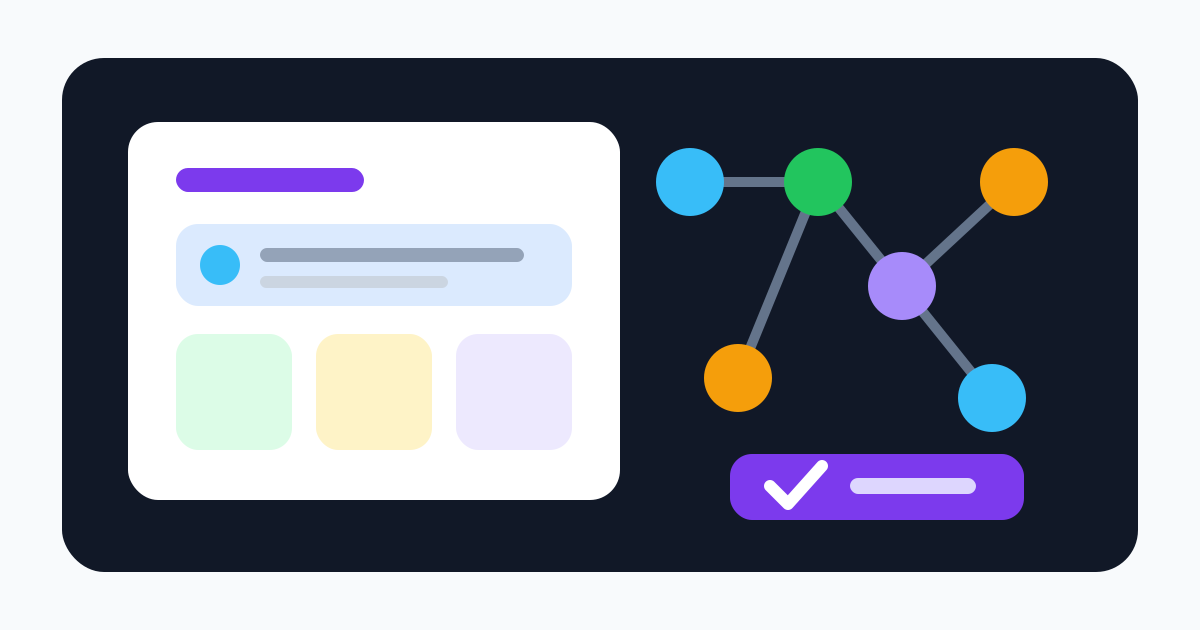
AI Agents can use connected tools, while the visual builder adds conditions, loops, code execution, and explicit routes. MCP can make workflows or actions callable from compatible clients. Treat every callable tool as a permission boundary. Give a research agent read-only access where possible; separate draft creation from publishing; restrict recipients, accounts, and record types; and never assume a natural-language tool description is an authorization control.
Before enabling an agent, create a small evaluation set containing normal inputs, missing fields, conflicting instructions, prompt injection, duplicate events, unavailable APIs, rate limits, and attempts to reach unauthorized data. Review the exact tool selected, arguments sent, output returned, latency, cost, and downstream change. A good demo is not evidence that an open-ended workload is safe.
Human approval and recovery design
Activepieces documents human-in-the-loop approval for flows and agents. Approval is most useful immediately before an irreversible or externally visible action: sending a customer message, issuing a refund, changing a CRM owner, publishing content, or deleting a record.
The review request should show the original input, proposed action, target system, changed fields, supporting evidence, and expected downstream effect. Test approve, reject, edit, timeout, reassignment, and duplicate-click behavior. If source data changes while an approval is pending, require revalidation. If a run retries, an idempotency key should prevent a second email, payment, or record.
Approval does not replace least privilege. A compromised workflow with an approval button can still expose sensitive context or create misleading requests. Use separate service accounts, narrow OAuth scopes, connection ownership, environment separation, and an emergency disable procedure. Decide how to replay failed runs and how to reconcile partial completion across several applications.
Cloud pricing and credit model
The Activepieces pricing page checked on August 7, 2026 lists Free at $0, Plus at $16 per month billed yearly, Team at $166 per month billed yearly, and custom Ultimate pricing. Free is for one user with daily-refreshing credits. Plus supports up to five users, monthly credits, pay-as-you-go overage, and bring-your-own AI keys. Team includes 25 users, projects, global connections, SSO, standard roles, and email support. Ultimate adds capabilities such as custom roles, SCIM, audit logs, secret managers, Git Sync, releases, and priority execution.
The published meter matters more than the plan label. A flow run costs one credit even when it has several ordinary steps. An agentic action costs one credit. Listed AI model usage ranges from two credits for a fast model to twenty for a frontier model, while use of a customer AI key costs one platform credit in addition to the external model bill. Paid-plan overage is listed at $0.007 per credit.
Model a real trace, not a happy-path diagram. Count repeated loops, model retries, agent tool calls, polling, failure recovery, test runs, and external API charges. Confirm the current checkout because prices, included credit quantities, and promotions can change. Set budget alerts and define whether work pauses or continues into overage.
Self-hosting and edition boundaries
Activepieces Community Edition can be deployed with Docker, Docker Compose, or Kubernetes. The pricing FAQ describes it as free and open source with no cap on runs, users, or flows. It also states that Community Edition excludes Agents and Chat, projects, API access, and the team and administration layer, including SSO, roles, audit logs, secret managers, branding, and Git Sync.
Self-hosting therefore solves deployment control, not every product requirement. It also creates operational work: database and queue availability, encryption keys, OAuth callback configuration, secret rotation, outbound network policy, worker isolation, upgrades, backups, disaster recovery, monitoring, log retention, and vulnerability response. Run a restore exercise before placing business-critical workflows on the platform.
Compare the exact licensed edition against the controls you need. If audit trails, private integrations, SCIM, custom roles, or vendor support are mandatory, obtain written plan and contract confirmation rather than inferring them from the open-source repository.
Security and privacy questions
The security documentation says credentials use 256-bit encryption keys, sensitive values are masked in logs, and OAuth scopes are limited when providers allow it. It also lists RBAC, SSO, audit logs, and a Germany cloud region, though availability depends on edition and plan. Verify these controls in the environment you will actually buy or deploy.
The privacy policy explains that workflow data may include customer end-user information and that connected third-party services follow their own policies. It says Activepieces does not sell or rent customer-provided personal data and describes retention, subprocessors, international transfer, and Google Workspace API restrictions. These public statements do not replace a DPA, subprocessor review, deletion test, or data-flow map.
Use synthetic records in evaluation. Document which fields enter Activepieces, where run history and tables persist, what reaches AI providers, who can inspect logs, and how deleted records are removed from backups. The terms state the software is not designed for specified sensitive-data categories without prior written consent, so regulated workloads require contract and legal review.
Who should choose Activepieces?
Activepieces belongs on the shortlist when a team wants approachable visual automation, an open-source self-hosting path, and a route from deterministic flows to AI agents with approval. It is particularly attractive when ordinary multi-step flows should have a predictable base meter and when developers are willing to extend TypeScript integrations.
Choose n8n when its node ecosystem, code-oriented workflow model, and licensing fit better. Choose Make when a mature visual scenario canvas and managed operations are the priority. Choose Zapier AI when broad SaaS integration coverage and an established Zapier operating model outweigh self-hosting. The AI automation and agent tools category provides a wider approval, permission, cost, and recovery checklist.
Visit Activepieces