
What is Clay?
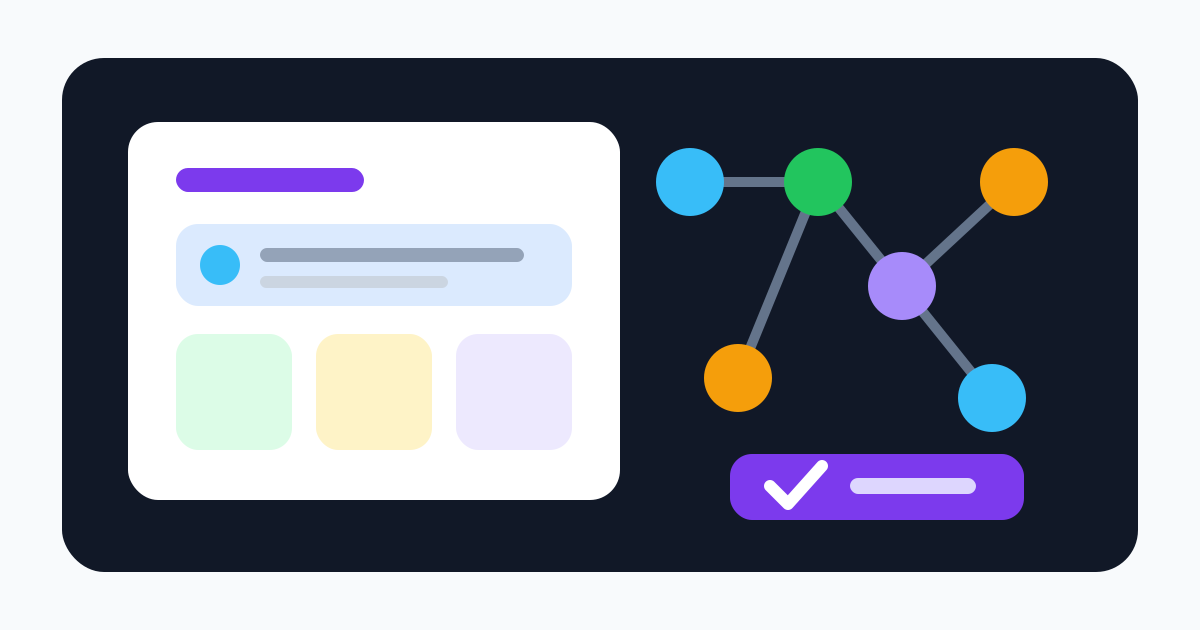
Clay is a data-enrichment and go-to-market orchestration platform organized around spreadsheet-like tables, a provider marketplace, AI research agents, signals, audience profiles, and actions into CRM, advertising, and sequencing systems. It is designed to help GTM teams source accounts, enrich people and companies, research fit, score records, personalize messages, and keep systems current without building every integration themselves.
The important distinction is orchestration. Clay does not represent one canonical data source. A workflow may start with CRM records, a CSV, Clay's company database, a warehouse, or a search; try several third-party providers in a waterfall; use Claygent to research the web; calculate a score; then write to Salesforce, sync an ad audience, or enroll a person in a sequence. Quality and legality therefore depend on the entire chain.
Enrichment, waterfalls, and provenance
Waterfalls try providers in order until a field is found, improving coverage and avoiding some unnecessary calls. Run conditions can limit enrichment to qualified rows, and BYO provider keys may reduce Clay credit use. Functions package a multi-column workflow for reuse; the function itself adds no meter, while each enrichment inside still consumes its normal credits or actions.
More coverage does not guarantee truth. Names collide, people change companies, domains are shared, catch-all email validation is uncertain, phone ownership changes, and public profiles can be outdated. Store provider, source URL where available, retrieval date, confidence, waterfall order, and validation state with every material field. Sample by provider and segment, not only overall fill rate, and never overwrite verified first-party CRM values silently.
Claygents can navigate the web and return researched answers row by row. They are useful for qualitative facts that a structured provider lacks, but webpages can be wrong, stale, adversarial, or ambiguous. Require cited evidence, constrain allowed sources, mark inference separately from observed facts, and review any claim used for targeting, personalization, qualification, or exclusion.
Audiences, signals, and execution risk
Audiences combines CRM, warehouse and third-party data into persistent contact and account profiles. Current documentation says Growth can synchronize up to 250,000 CRM or warehouse records daily, while Enterprise can handle up to 25 million with 15-minute refresh; Launch sources from Clay's database and CSV. Actual limits and connectors remain plan-dependent.
Signals watch events such as job changes, promotions, new hires, news, fundraising, or mentions. Continuous enrichment can automatically update new matching records. These features make outreach timely, but a false match can become an intrusive message. Set a look-back window, recurrence, cost budget, minimum confidence, expiry, and human approval for consequential triggers.
CRM writeback, advertising audience sync, webhooks, and the native Sequencer move Clay from analysis into execution. Use a staging field rather than overwriting production, deduplicate by stable identifiers, respect global suppression and opt-outs, cap daily sends, separate enrichment from send permission, and require approval for new campaigns. Never let an AI-written personalization invent a relationship, event, quote, or problem.
Current pricing: two meters
Clay's newer pricing uses data credits and actions. Data credits pay for marketplace data such as emails, phone numbers, company fields, and some AI enrichment; cost varies by provider and field. Actions meter work Clay orchestrates—enrichment calls, AI research, CRM sync, CSV export, sequencer send, and more. Clay says most customers do not hit the action limit, but buyers should model it rather than assume it is irrelevant.
Launch starts at $185/month with 2,500 credits and 15,000 actions, intended for fewer than 1,000 enriched records monthly. Growth starts at $495 with 6,000 credits and 40,000 actions, adding CRM integration, HTTP API, web intent, advanced automation and Audiences. Enterprise is custom and adds volume economics, onboarding, warehouse integration, SSO and RBAC. The 14-day trial has 1,000 credits, key integrations and API access, but excludes phone enrichment.
Calculate cost per accepted, reachable, permitted contact—not per row enriched. Include waterfall calls, recurring signals, AI steps, retries, actions, provider subscriptions under BYO keys, CRM and sequencer seats, implementation, QA, bounces, complaints, and deletion work.
Privacy, AI, and security
Clay says customer data is not used to train Clay or provider AI models, AI processing happens only when an action is run, and users choose the context columns. It reports encryption at rest and in transit, SOC 2 Type II, ISO 27001, and primary processing in AWS US-East. Its AI documentation says workspace deletion removes data after 30 days; verify account, backup, log, integration and provider behavior contractually.
Clay often processes professional personal data at scale. The customer remains responsible for the lawful basis, transparency, source notice, purpose limitation, accuracy, rights requests, retention, international transfer, do-not-contact lists, and rules such as GDPR/ePrivacy, CAN-SPAM, CASL, TCPA or local equivalents. B2B status does not make every channel or jurisdiction unrestricted.
Map every subprocessor and destination. Restrict who can connect providers, expose API keys, create exports, synchronize audiences or launch sends. Use service accounts and least privilege, rotate keys, separate client workspaces, and test whether deletion propagates to CRM, warehouse, ad network, sequencer and downloaded files.
Verdict
Clay is powerful when a capable GTM operations team needs to combine sources and turn verified signals into measured action. Its waterfalls, Claygents, Audiences, functions, and execution integrations can replace a brittle stack of spreadsheets and point automations.
It is not a shortcut around data quality or outreach law. Start with a narrow ICP and one permitted channel, preserve provenance, validate provider performance, forecast both meters, stage CRM writes, centralize suppression, and measure replies, opportunities, complaints and deletions. Scale only workflows whose data and conduct remain defensible.