What Langflow is
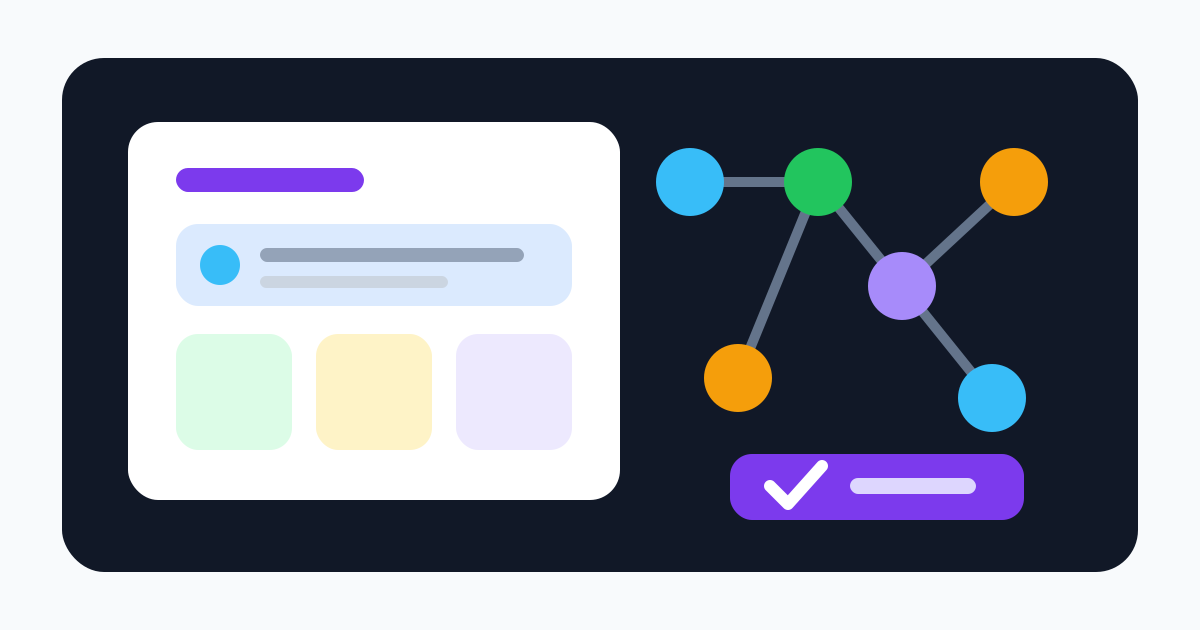
Langflow is a visual development environment and Python runtime for AI applications. Builders connect model, prompt, data, retrieval, memory, Agent, tool, API, MCP, and custom components on a canvas. A flow can be tested in a playground and exposed through APIs, MCP, A2A, or an application integration.
The project is genuinely MIT-licensed, unlike source-available products with commercial restrictions. That provides deployment freedom, but not a managed security outcome. The operator chooses models, databases, hosting, authentication, logging, and connected services and is responsible for the resulting system.
Agents, RAG, MCP, and A2A
Langflow's Agent component can use model-native tools, connected components, MCP servers, and even other Agents. Retrieval components support RAG patterns across files, databases, and vector stores. Flows can also act as MCP or Agent2Agent endpoints.
These protocols make reuse easier but widen access. An MCP server may expose database queries or write actions to an external client. An A2A card may intentionally publish discovery metadata. Document which endpoints are public, who owns credentials, what input is accepted, and which tools can create side effects.
Use one Agent when one is enough. Put deterministic validation, routing, authorization, and output schemas around it. Multi-agent graphs increase cost and make responsibility harder to trace. Require citations or retrieved identifiers when a result depends on a knowledge base.
Human-in-the-loop and traces
Langflow's Agent tool documentation allows a builder to mark a specific tool as requiring approval. The run pauses before the tool call and resumes after a human approves or rejects. A Human Input component can implement explicit branches and allow a reviewer to edit or comment.
Place approval immediately before a consequential tool, not after its effect. Show the exact arguments, target, and relevant evidence. Test timeouts, rejected requests, multiple reviewers, and a browser refresh while the checkpoint is open.
Native traces record flow runs and component spans, including inputs, outputs, errors, latency, model and token information, and human-gate decisions. Traces are enabled by default under the current documentation and stored in Langflow's database. This helps debugging but can duplicate sensitive prompts, documents, and tool results. Limit access, retention, exports, and backups.
Authentication and production hardening
Langflow authentication documentation warns against exposing Langflow ports directly without security controls. It recommends disabling automatic login, setting a non-default secret, configuring a superuser password, using authenticated reverse-proxy deployment, and protecting API keys. Official Docker images currently set automatic login to false, but the operator still must configure credentials.
Shared or untrusted deployments need more. Langflow has controls to block arbitrary code components and restrict built-in file readers to its configuration directory; current documentation shows those restrictions are not universally true by default. CodeAct, Python interpreter, file, directory, CSV, JSON, OpenAPI, and custom components can cross the expected boundary if enabled broadly.
SSRF protection blocks many private-network targets, but connector settings and loopback exceptions require review. Allowing localhost is convenient for Ollama or LM Studio and dangerous when an untrusted tenant can reach services on the host. Use container isolation, network policies, allowlists, separate secrets, and a runtime identity with minimal filesystem access.
Pricing and operating cost
The Langflow repository is free under MIT. The official site also advertises a free cloud account but does not present a simple public quota table in the materials reviewed here. Confirm hosted limits, data terms, regions, retention, and enterprise support directly in the current service.
Self-hosting still costs compute, database, storage, vector search, model APIs, monitoring, backups, patching, and engineering. Separate the full authoring IDE from a production runtime where possible. Pin versions and components, export flows, test upgrades, and maintain a rollback.
Who should choose Langflow?
Langflow is a strong fit for teams that want visual AI development without surrendering Python customization or license freedom. It is less suitable as an ungoverned shared sandbox or as a replacement for a mature catalog of business SaaS actions.
Compare CrewAI for code-first role-based agent orchestration, Dify for a packaged workflow, RAG, and app platform, and n8n for integration-heavy automation. See the AI automation and agent tools category for a production checklist.
Visit Langflow