What is Clearscope?
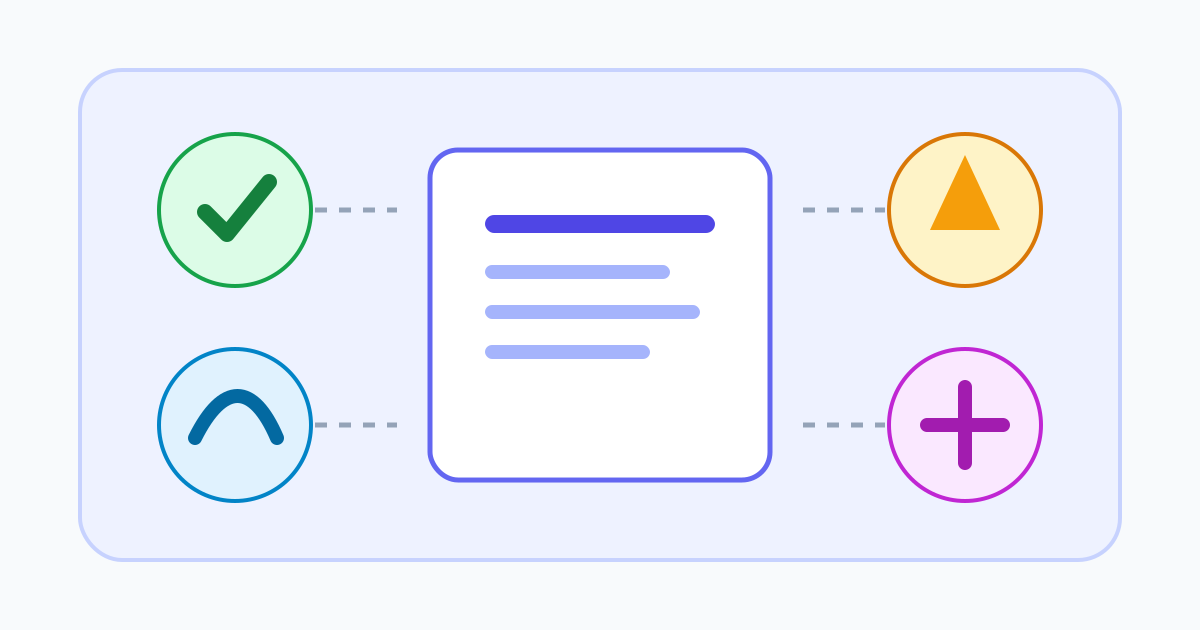
Clearscope is a content optimization platform for traditional search engines and AI-mediated discovery. It helps a team discover topics, analyze live search results, understand dominant intent, build briefs, draft or edit content, monitor published pages, identify internal-link opportunities, and track whether a brand or domain appears in sampled AI responses. Its current product language spans Google visibility, ChatGPT and Gemini mentions, citations, and the searches models use to construct answers.
The core workflow is a Clearscope Draft, formerly called a Content Report. For a target query and locale, Clearscope says it simulates a search, pulls the top 30 desktop and mobile pages, analyzes terms, structure, intent, and competition, then recommends concepts, questions, sources, headings, word count, readability, and a Content Grade. The editor works in Clearscope or through Google Docs, Microsoft Word, and WordPress integrations.
Research, grading, and AI drafting
Clearscope's Content Grade estimates relevance and comprehensiveness based on language used in ranking pages and other search signals. The term list is useful as a coverage audit: it can expose a missing definition, comparison criterion, exception, audience question, or related entity. Intent grouping can prevent a team from publishing a product page where searchers expect a tutorial.
The grade should guide, not dictate. Copying every suggested term can homogenize a page, encourage unnecessary length, and reproduce the blind spots of current results. Ranking pages are evidence of what a search engine currently returns, not proof that each page is correct or that an average synthesis is better. The strongest content adds primary research, original data, expert analysis, a clearer tool, a better explanation, or a decision framework that competitors lack.
Draft with AI can generate an outline and first pass based on intent, content type, and a selected tone or reference page. Treat it as unverified source material. Check every fact, quotation, statistic, recommendation, product claim, date, and citation against primary sources. Remove invented examples, generic filler, unsupported superlatives, and phrasing too close to competitors. Record the human author and editor rather than publishing an opaque machine draft.
Content inventory and AI visibility
Content Inventory tracks published pages, their grades, GSC context, decay or striking-distance opportunities, and custom views. Tracked Topics and Prompt Tracking add AI mentions, citations, response text, model, polling time, competitor context, and sometimes the web searches used by an AI system. This can identify prompts where a competitor is cited and suggest content gaps.
These metrics are samples, not a census of AI visibility. Responses change with model version, location, personalization, prompt wording, search state, and randomness. A brand mention can be negative; a citation may generate no click; a response without a citation may still influence a decision. Preserve the exact prompt, model, run time, geography, sample count, rolling window, citation definition, and competitor configuration. Pair the result with referral traffic, branded search, assisted conversion, sales feedback, and controlled content experiments.
Pricing and credit economics
Clearscope currently lists Essentials at $129 per month: 50 tracked prompts, 50 Content Inventory pages, 20 monthly Topic Explorations, and 20 monthly Drafts. Business is $399 per month: 300 prompts, 300 pages, 50 explorations, and 20 Drafts, plus a dedicated account manager. Enterprise has custom credits, agreements, crawler allow-listing, and SSO. All plans advertise unlimited users and projects, onboarding, support, sharing, and export. A 14-day trial is available.
Topic Exploration and Draft creation draw from separate credit pools, while pages and tracked prompts have their own limits. The pricing page advertises page and Draft add-ons but does not make the quantity represented by every displayed add-on price obvious in the extracted page, so confirm it at checkout. Also reconcile the pricing page's “cancel anytime” wording with the general terms, which describe automatic renewal and a 30-day termination notice. Obtain the exact order terms for annual or Enterprise purchases.
Model cost per useful decision: topics accepted into the roadmap, briefs approved, pages materially improved, decay prevented, qualified traffic, and conversion—not grades raised or terms inserted. Business costs the same 20 monthly Drafts as Essentials, so a high-volume team may need add-ons or Enterprise even before it reaches the prompt or page limits.
Data, integrations, and public terms
Connecting GSC exposes valuable property and performance data. Clearscope's support page says it uses GSC data exclusively to verify and provide content insight and does not share, sell, or sample that data. Google Docs shared Draft links can be accessible to anyone with the link, so sharing settings and Workspace OAuth approval deserve review. WordPress access should be limited to required scopes and a non-production test where possible.
The broader public legal posture needs due diligence. The privacy policy is still marked “Updated October 5, 2017,” despite major AI drafting, prompt monitoring, and integration features added since. The Terms say Customer Data is confidential and customer-owned, but also allow Clearscope to collect and analyze information concerning Customer Data and derived data to improve services and disclose it in aggregate or de-identified form. After termination, data is available for retrieval for 30 days, after which Clearscope may—but is not obligated to—delete it.
Before sensitive use, request the current DPA, security controls and independent reports, subprocessor list, regions, encryption, access logs, incident notice, backup retention, model providers, AI-training and improvement rules, prompt-response retention, deletion commitment, and integration scopes. Do not assume a generic 2017 website privacy template answers a 2026 enterprise AI data-flow question.
Verdict
Clearscope provides a coherent workflow for teams that already take content strategy and editorial quality seriously. Live SERP analysis, semantic coverage, inventory, GSC context, integrations, and AI-visibility samples can help prioritize work and expose gaps.
It cannot manufacture authority or guarantee discovery. Use its recommendations as research signals, protect original judgment and information gain, measure outcomes beyond scores, and resolve the outdated public privacy notice and broad improvement language before connecting sensitive systems. The best use of Clearscope makes a strong editorial process more informed—not more formulaic.