What is NotebookLM?
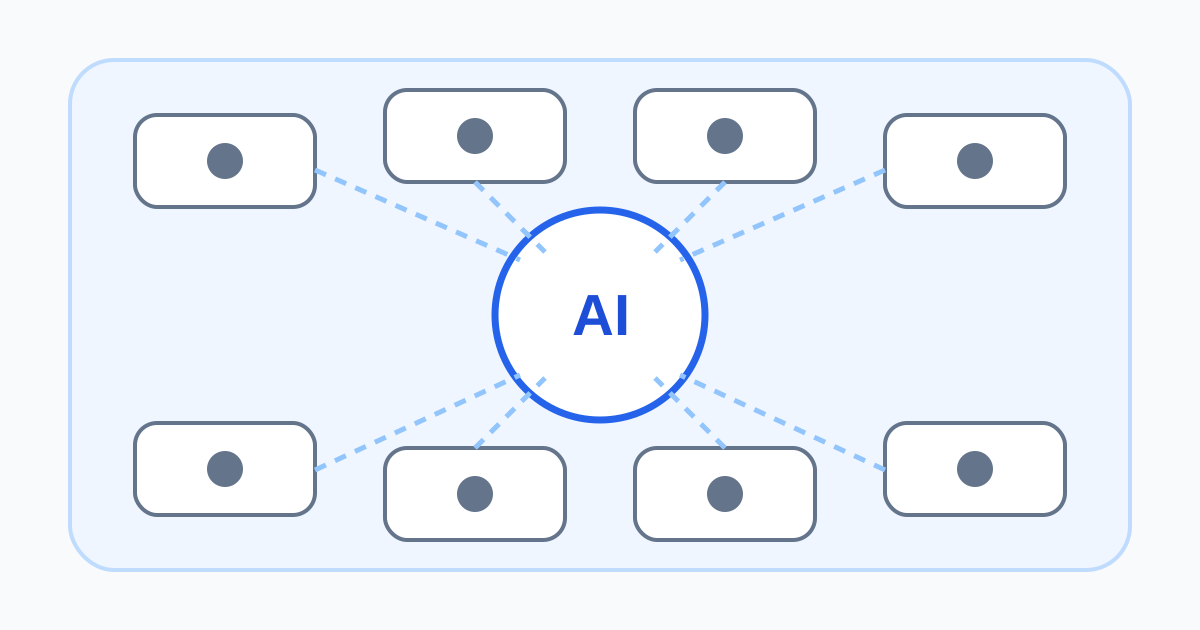
NotebookLM is Google's source-grounded research and learning assistant. A user creates a notebook, adds selected sources, and then asks questions or generates outputs from that collection. Standard NotebookLM chat is designed to use the notebook's sources rather than answer from an unrestricted mix of web knowledge.
That boundary makes NotebookLM different from a general assistant. It is most useful when the material already exists: research papers, policies, reports, interview transcripts, course readings, websites, videos, or other supported sources. The product helps a user navigate and transform that material, but it does not make weak, incomplete, or outdated sources authoritative.
Source-grounded chat and citations
NotebookLM chat can answer questions about the source collection and provide citations tied to source passages. Google's official guidance says users can hover over a citation to inspect quoted context and select it to navigate back to the relevant location.
This creates a stronger verification path than an answer without source mapping. It still requires judgment. Check whether the quoted passage supports the whole claim, whether another source contradicts it, and whether a table, footnote, or definition changes the interpretation. If an answer is not present in the sources, NotebookLM may decline rather than fill the gap with general knowledge.
A useful setup starts by separating notebooks by project or decision. Use clear source names, remove duplicates, and include documents that represent different perspectives. Ask known-answer questions first. Then request a source comparison, an uncertainty list, or a table that identifies which source supports each conclusion.
Reports, overviews, and learning artifacts
NotebookLM can generate more than chat responses. Official help material documents reports, Audio Overviews, Video Overviews, flashcards, quizzes, mind maps, infographics, slide decks, data tables, and other artifacts, with availability and limits depending on the account.
These outputs are useful for changing the way material is consumed. An audio overview can introduce a source set during a commute, while a mind map can reveal major themes before close reading. A quiz can expose gaps in understanding. None of them should replace the source for precise quotation, assessment, compliance, or publication.
Public notebooks can be shared with eligible viewers. Before sharing, inspect every source and generated artifact. Google's guidance notes that viewers may be able to access underlying source material even when a focused chat view is used. Do not publish licensed, personal, or confidential content without the necessary rights.
Access, limits, and mobile differences
Google's NotebookLM FAQ documents standard access and current usage limits. Expanded access is tied to qualifying Google AI subscriptions, Workspace editions, education plans, or enterprise options. Limits are subject to change and can differ for notebooks, sources, chats, artifacts, and advanced research.
The mobile apps support important core workflows, but Google's help center notes that some features can be limited compared with desktop. If mind maps, reports, tables, analytics, or advanced sharing are essential, verify them on the intended device before choosing a plan.
Privacy and data handling
Google's NotebookLM privacy and terms page states that uploaded files, generated outputs, and chat history are used to build the notebook knowledge base and assist the user. It says this content is not used directly to train Google's foundational generative models unless the user chooses to provide feedback.
Feedback changes the context: submitted prompts, sources, customizations, and outputs can be collected and reviewed to improve the product. Google documents additional protections for eligible Workspace and education users, including situations in which uploads, queries, and responses are not human reviewed or used to improve models.
Always verify the account type. A personal Google account, a managed Workspace account, and an education account can have different terms. Remove unnecessary sensitive information, check sharing settings, and confirm that every source is permitted for the intended use.
Strengths and limitations
NotebookLM's strongest advantage is a clear source boundary with navigable citations. It can turn a document collection into several useful formats without losing the route back to evidence.
Its main limitation is dependence on the input collection. Missing sources produce missing context; biased sources can produce a biased synthesis. Generated artifacts may simplify disagreement or overstate a theme. Users still need to read and evaluate the original material.
Who should choose NotebookLM?
NotebookLM is a strong fit for research, study, policy, and content projects built from an approved source set. Compare Perplexity when discovering current web sources is the main task, Gemini when open-ended Google-connected assistance matters, or Claude when iterative drafting across broader material is the priority.
Visit the official NotebookLM website