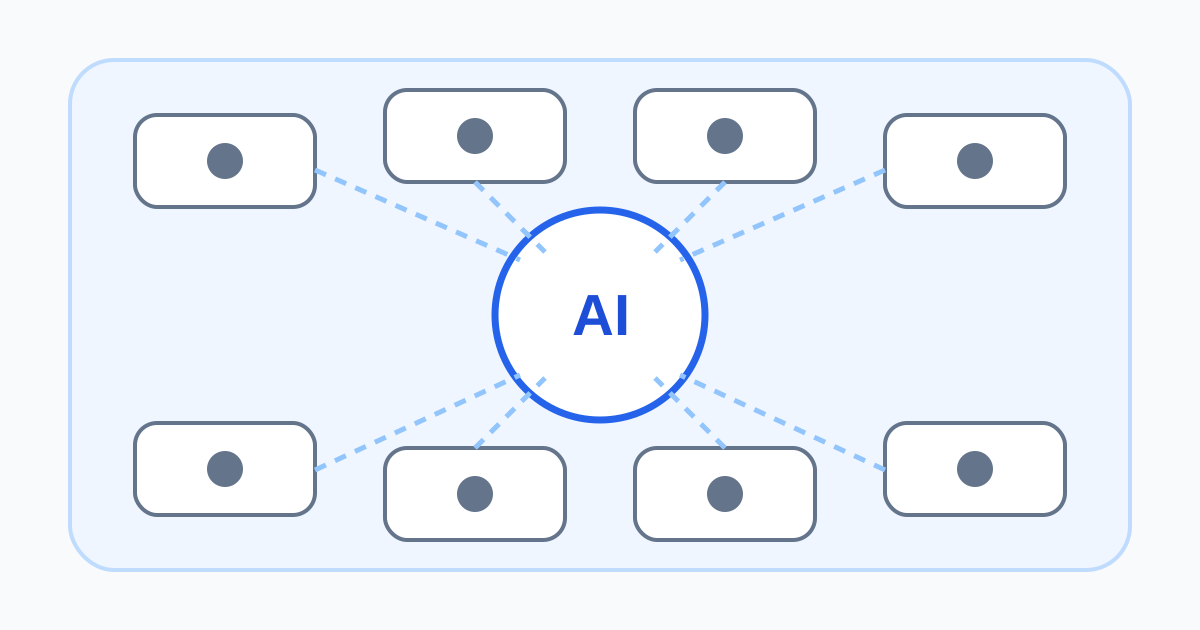
The best ChatGPT alternative depends on the problem you are trying to solve. If the issue is long-form writing, Claude may deserve the first test. For source-led web research, Perplexity is more focused. NotebookLM is designed around material you provide. Gemini and Microsoft Copilot fit particular software ecosystems. Poe offers access to many bots and models, while Mistral Vibe, DeepSeek, and Grok bring different product, provider, or real-time information choices.
None is a universal drop-in replacement. A product can be better for one workflow and worse for the next. Switching also does not remove the need to verify facts, inspect privacy terms, or compare actual limits.
This guide is based on official product, pricing, help, and privacy sources reviewed in August 2026. It is a researched fit comparison, not a controlled model benchmark. See our ChatGPT review and AI assistants and search category for broader context.
Quick recommendations
| If you want... | Start with | Why | Main caution | | --- | --- | --- | --- | | Iterative writing, analysis, documents, and coding | Claude | Strong product fit for staged knowledge work, projects, research, and Claude Code | Long context does not guarantee complete understanding | | Google ecosystem connections | Google Gemini | Designed around Gemini Apps and eligible Google services | Features and data behavior vary by account, connector, region, and plan | | Source-led web answers | Perplexity | Search-first interface with visible sources and research workflows | A citation can exist without fully supporting the claim | | Microsoft consumer ecosystem | Microsoft Copilot | Broad assistant tied to Microsoft consumer products and platforms | Do not confuse it with Microsoft 365 Copilot or GitHub Copilot | | Many models, bots, and creator experiences | Poe | One interface for model access, bot discovery, and bot creation | Point pricing and bot-level privacy require careful inspection | | Mistral's work, chat, and code direction | Mistral Vibe | Unified successor to Le Chat with productivity and coding workflows | Rename and product transition make older reviews obsolete | | A separate model provider and low-cost access | DeepSeek | Consumer app, API, and open-model ecosystem provide several access paths | App, API, and open weights have different privacy and deployment implications | | Answers grounded in your source collection | NotebookLM | Notebook-based questions, citations, research, and Audio Overviews | Source grounding does not make the uploaded sources correct or complete | | Real-time web and X context | Grok | Web and X search can surface fast-moving public discussion | Speed and social sources increase verification risk |
First identify why ChatGPT is not working
Before moving, write down the specific failure. Common reasons include:
- the writing style needs too much correction;
- citations are hard to verify;
- documents are not handled as expected;
- the organization depends on Google or Microsoft services;
- a particular coding workflow is missing;
- the team wants access to several model providers;
- privacy or regional requirements do not fit the intended account;
- limits interrupt a repeated task;
- real-time information is the main need.
Without a defined reason, users often replace one broad assistant with another and discover the same limitations. Pick one representative task, define approval criteria, and compare only products that address the failure.
Claude: best starting point for iterative knowledge work
Claude is the closest broad alternative in this list. It supports conversation, writing, analysis, files, web research, coding, projects, connectors, and desktop and mobile use. Claude Code adds a distinct developer workflow.
Claude is especially worth testing when a task develops in stages: read material, discuss structure, draft, critique, revise, and continue within a project. Writers, analysts, researchers, and developers may prefer its interaction style or product organization.
Do not choose it solely because a review mentions a large context window. Access to more text does not prove that every paragraph, footnote, or contradiction received equal attention. Test known facts and source locations inside your own document.
Anthropic offers free and paid individual, team, enterprise, and education options. Consumer and commercial contexts should not be assumed to share identical data rules. For a direct decision, read our ChatGPT vs Claude comparison.
Google Gemini: best for eligible Google connections
Google Gemini is a strong candidate when the user already works heavily within Google's ecosystem. Gemini Apps can connect to eligible Google services and provide conversational, research, file, and media workflows, depending on the account, region, plan, and current feature availability.
The ecosystem benefit is reduced switching. A useful test should involve the actual Google service and permission scope you expect to use, not a generic prompt. Confirm what data the connector can read, what action it can take, and whether work and personal accounts behave differently.
Gemini's standard and paid access can vary by account type and capacity. Product features, connected apps, and data practices require separate review. Choose it when Google integration solves a repeated problem, not merely because another assistant also has a Google-related feature.
Perplexity: best for source-led web research
Perplexity is built around asking a question, searching the web, and presenting an answer with visible sources. Its product also includes organized research spaces, file workflows, advanced research modes, model choices, and API options according to the current plan.
This focus makes it a practical ChatGPT alternative when discovery and citation inspection dominate. It is easier to begin verification when sources are part of the interface.
Visible citations do not guarantee factual support. Open each link, inspect the date and authority, and confirm that the page supports the exact sentence. Perplexity can also synthesize weak, secondary, or conflicting sources into a confident answer. Use primary documents for consequential work.
Choose Perplexity when research is the main workflow and the team has a disciplined source-review process.
Microsoft Copilot: best for the Microsoft consumer ecosystem
Microsoft Copilot provides a broad consumer assistant across supported web, desktop, mobile, search, image, voice, and Windows-related experiences. Eligible Microsoft subscriptions may add capabilities or higher limits.
The name creates procurement confusion. Consumer Copilot is not the same product as Microsoft 365 Copilot for organizations, GitHub Copilot for developers, or Copilot Studio for building agents. Each has different licensing, administration, data terms, and intended users.
Evaluate the exact product and subscription. A consumer user may value cross-device access and Microsoft services, while an organization should compare the commercial Microsoft 365 offer under its own governance requirements.
Choose Microsoft Copilot when the relevant Microsoft product relationship reduces repeated friction and the plan is clearly identified.
Poe: best for model and bot variety
Poe is a multi-model and bot platform. Users can access experiences from different providers, discover creator-built bots, and create bots or apps for particular tasks. This is materially different from choosing one assistant provider.
Poe is useful for comparison and discovery. A user can try several models or specialized bots without maintaining a separate interface for each one. Its point-based subscriptions, however, require task-level cost inspection: different bots and actions consume different amounts.
Privacy also operates at more than one level. Inspect the bot description, creator, provider, privacy shield, point price, and connected services. A popular bot is not automatically accurate or suitable for confidential information.
Choose Poe when model breadth and bot discovery are the reason to leave ChatGPT, and you are comfortable evaluating each experience separately.
Mistral Vibe: best for Mistral's unified workflow
Mistral Vibe is the successor to Le Chat. Mistral announced the Vibe name in June 2026 and describes Work, Chat, and Code directions across productivity, conversation, and development surfaces.
The product is worth evaluating for users interested in Mistral's provider ecosystem and a unified assistant that extends from web and mobile work into command-line or editor workflows. Existing Le Chat accounts and historical material may continue to appear during the transition.
The transition is also the main caution. Older reviews, screenshots, links, plan names, and tutorials can age quickly. Confirm that instructions refer to Vibe's current interface and distinguish product access from Mistral's separate API offerings.
Choose Mistral Vibe when its work-and-code direction or provider choice is itself valuable, not as a generic one-to-one clone.
DeepSeek: best for multiple deployment paths
DeepSeek spans a consumer chat app, a separately billed developer API, and an open-model ecosystem. This gives evaluators several ways to use the provider, from a hosted conversation to technical integration or self-managed deployment.
Those options must remain distinct. Using open weights does not mean the consumer app is local or private. Self-hosting can increase control but also makes the operator responsible for infrastructure security, access, updates, logging, and model behavior. API data terms and token pricing differ from the app.
DeepSeek is worth testing when provider diversity, API economics, or open-model access matters. Organizations should review jurisdiction, processing location, applicable policy, and their ability to operate a secure deployment before sending sensitive material.
Choose DeepSeek when the alternative access path is a real requirement and the team can evaluate its privacy and operational consequences.
NotebookLM: best for a defined source collection
NotebookLM begins with sources selected by the user. A notebook can support questions, citations back to source material, research organization, and outputs such as Audio Overviews, with limits and features varying by eligible account or plan.
This grounding model is useful when the task is “help me understand these materials” rather than “answer from the entire web.” It can reduce drift beyond the source set and make navigation easier.
The source collection remains the boundary. If a document is outdated, biased, incomplete, or wrong, a grounded answer can faithfully reproduce the problem. Test known answers, inspect citations, and label conclusions that require external evidence.
Google documents different handling around accounts, feedback, and service improvement. Confirm the rules that apply to the exact personal, Workspace, education, or enterprise context.
Choose NotebookLM when a curated body of material is the center of the workflow.
Grok: best for real-time web and X context
Grok emphasizes current information through web and X search alongside conversation, reasoning, voice, and media features. It is available through a standalone product and in X-related contexts, with free and paid access changing over time.
Real-time social information is valuable for monitoring public reaction, breaking topics, or emerging language. It is also noisy. Viral posts can be wrong, coordinated, satirical, or stripped of context. Speed increases the need to identify the original source and wait for confirmation where appropriate.
Distinguish standalone Grok, Grok inside X, business or enterprise offers, and API access. Their plans and data contexts should not be treated as identical.
Choose Grok when live web and X information is central and the user has a strong verification process.
How to compare price and privacy
All nine products can change limits, plans, and regional availability. Compare the billing unit attached to your task: messages, searches, files, points, tokens, model access, connectors, projects, or organization seats. A free tier is useful for interface testing but may not represent sustained work.
For privacy, identify the exact product path. Consumer chat, business workspace, API, connected app, creator bot, and self-hosted model are different data decisions. Before using real material, verify training or improvement use, retention, deletion, human review, subprocessors, processing location, connector permissions, export, and organization controls.
A paid personal plan is not automatic permission to upload confidential company information.
A 30-minute alternative test
- Write the exact reason you want to replace ChatGPT.
- Select two alternatives that directly address that reason.
- Give each the same real input, constraints, and source packet.
- Allow one attempt, then record factual errors, missed instructions, and edit time.
- Inspect citations, file grounding, or tool actions independently.
- Map the task to the current plan's actual limit and privacy terms.
- Keep ChatGPT in the test as the baseline rather than assuming replacement is necessary.
The best alternative is the product that improves the identified failure without adding a larger problem elsewhere.
Final recommendation
Start with Claude for broad iterative knowledge work, Perplexity for source-led web research, NotebookLM for your own source set, Gemini or Microsoft Copilot for their respective ecosystems, Poe for model variety, Mistral Vibe or DeepSeek for provider and deployment choices, and Grok for real-time web and X context.
Do not switch because a single answer looks better. Run a repeated task, verify evidence, observe limits, and approve the exact data path. In many cases, the best decision is to use one focused alternative alongside ChatGPT rather than force one general assistant to handle every job.
Related guides
Continue with the ChatGPT vs Claude comparison and the best AI tools for small business to connect this decision with adjacent workflows and a consistent evaluation process.
