
What is VectorShift?
VectorShift is an enterprise agentic AI platform whose public positioning changed materially by 2026. The current website calls it an AI operating system for private-market investors, not primarily a general-purpose no-code AI builder. It focuses on virtual data room analysis, investment committee memos, portfolio monitoring, LP and DDQ work, financial analysis, presentation review, meetings, and institutional knowledge across deals.
The broader builder still matters. VectorShift's current documentation describes no-code pipelines, conversational and workflow agents, knowledge bases, chatbots, voicebots, code execution, tools, MCP servers, APIs, and external-app integrations. That foundation appears to power the finance product. However, documentation availability is not the same as a current commercial entitlement. A buyer should confirm which builder surfaces, APIs, nodes, models, deployment modes, and interfaces are included in the proposed package.
Private-market workflows and provenance
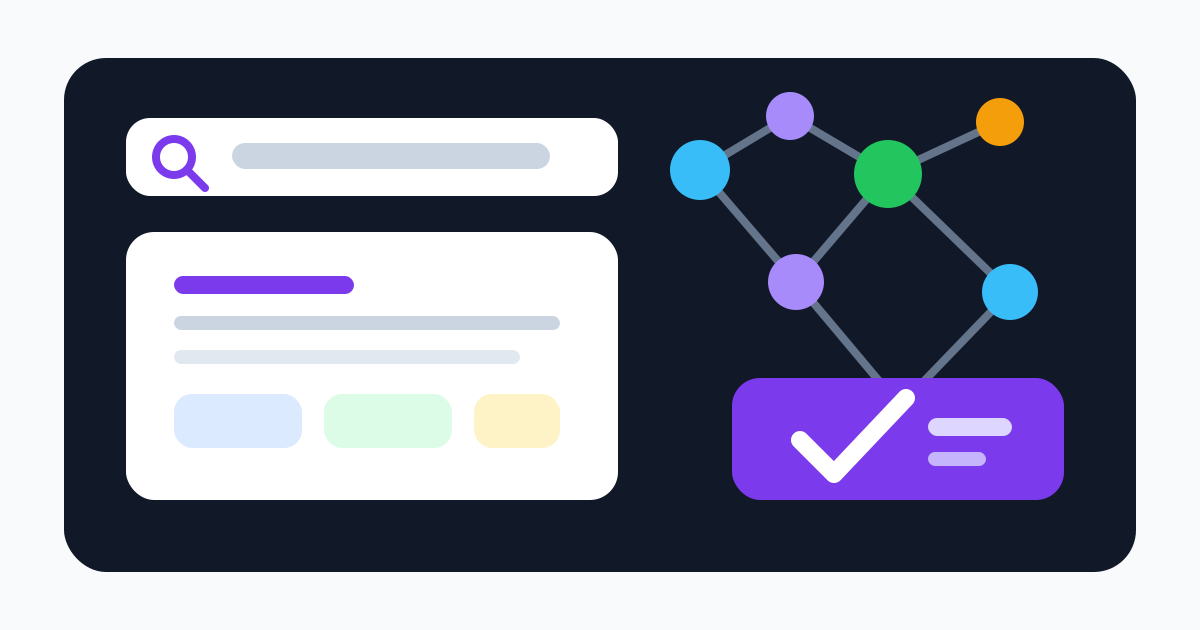
VectorShift says it unifies a firm's files, deals, and market data in a searchable knowledge layer. Named external sources include Capital IQ, FactSet, PitchBook, Crunchbase, Quartr, SEC and international filings, earnings transcripts, press releases, trading data, web, and news. Its skills library targets DCFs, LBOs, M&A analyses, comps, strip profiles, deck proofreading, sponsor overviews, and similar finance work.
Provenance is a central claim: figures and findings are meant to trace back to the document, page, and paragraph. That is valuable but does not prove the conclusion is correct. A system can cite the right page while selecting the wrong fiscal period, entity, currency, share class, adjusted metric, covenant definition, or scenario. Tables and footnotes are common failure points.
Build a golden evaluation set from completed deals with known answers. Test scanned PDFs, handwritten notes, messy spreadsheets, password-protected files, amendments, duplicate versions, conflicting sources, multiple currencies, fiscal calendars, and permission changes. Score extraction accuracy, citation entailment, formula integrity, source freshness, exception detection, reproducibility, and reviewer time—not only whether a memo looks polished.
Agents, workflows, and integrations
The documentation distinguishes agents from deterministic workflows. Agents can choose tools, query a knowledge base, search the web, read documents, run code, generate charts, call sub-agents, trigger workflows, and interact with applications. Workflows use a defined sequence of nodes for repeatable processing. Combining them can place reasoning inside a controlled pipeline or expose a tested pipeline as an agent tool.
Current product pages advertise more than 100 integrations, including SharePoint, OneDrive, Outlook, Excel, PowerPoint, OneNote, Box, Salesforce, DealCloud, and external financial data. Each connector expands the blast radius. A mis-scoped folder, inherited group, reused service account, or dynamic knowledge-base query can reveal material from the wrong deal. External data licenses may also restrict storage, derived data, display, and use in models.
Begin with read-only retrieval in a dedicated test fund. Use deal-level and document-level access, source allow-lists, separate build and production environments, short-lived credentials, action approvals, export restrictions, and audit logs. Require human sign-off before updating a system of record, sending email, publishing LP material, changing a model, or treating a generated number as investment evidence.
Pricing and total cost
VectorShift's current website does not publish a numeric price table. It asks buyers to request a demo and use a work email. Public subscription terms refer to monthly or annual subscriptions and website fees, but the current site no longer exposes a self-serve package. Old online price comparisons or historical pricing links therefore should not be used for a purchase decision.
Request a detailed quote for every user type, firm and portfolio-company access, data volume, storage, OCR, models, tokens, research, code, meetings, transcription, interfaces, API, connectors, financial data, environments, VPC or on-premises deployment, implementation, custom skills, evaluation, support, SLA, overages, price increases, and renewal. Add the internal cost of identity mapping, permissions, source cleanup, testing, reviewer training, monitoring, incidents, vendor changes, and exit.
Measure cost per approved workflow: a completed memo with verified citations, a checked DDQ, or a portfolio review accepted without material correction. Time saved in first drafting is not value if senior reviewers must reconstruct every figure.
Data, security, and contract review
VectorShift advertises SOC 2 Type II, GDPR and HIPAA compliance, AES-256 encryption at rest, TLS 1.3 in transit, regular testing, PII controls, role-based access, and deployment in a dedicated cloud, customer VPC, or on-premises. The product page says customer data is contractually excluded from model training and can remain inside the firm's perimeter under appropriate deployment.
The privacy statement similarly says VectorShift does not train AI models on customer data and uses DPAs with model providers so inference data is not used to improve their products. It also says a workflow may send uploaded data to a third-party model provider for inference. Service data is retained for the customer relationship and for a period afterward for operations, history, and archiving, without a public universal duration.
The August 2023 public subscription agreement grants VectorShift a service-delivery license to customer data and permits collection of component usage—such as models, prompts, and workflow organization—to improve the service. It caps general liability at fees paid in the preceding three months, or $1,000 for free service, and disclaims liability for workflow output and actions. A separately negotiated master agreement supersedes the public terms.
Enterprise procurement should verify the audit report, HIPAA scope and BAA if applicable, DPA, subprocessor list, model providers, inference retention, telemetry, prompt logs, single-tenant boundaries, keys, backups, deletion schedule, incident notice, business continuity, penetration tests, data residency, external-data rights, IP, output ownership, indemnities, liability, and exit exports.
Verdict
VectorShift is now most relevant as a vertically focused platform for investment firms, not merely another drag-and-drop AI automation builder. Its combination of provenance, financial sources, firm knowledge, reusable skills, and agentic orchestration could shorten high-volume private-market work where the same analytical patterns recur.
The purchase requires enterprise diligence. Pricing is quote-only, the public product direction has moved beyond older self-serve positioning, and financial agents can amplify errors or permission failures. A sound rollout starts with a narrow read-only workflow, a golden deal set, exact source and access tests, written unit economics, contract-level data controls, and expansion only after accountable reviewers consistently approve the results.