What Consensus is
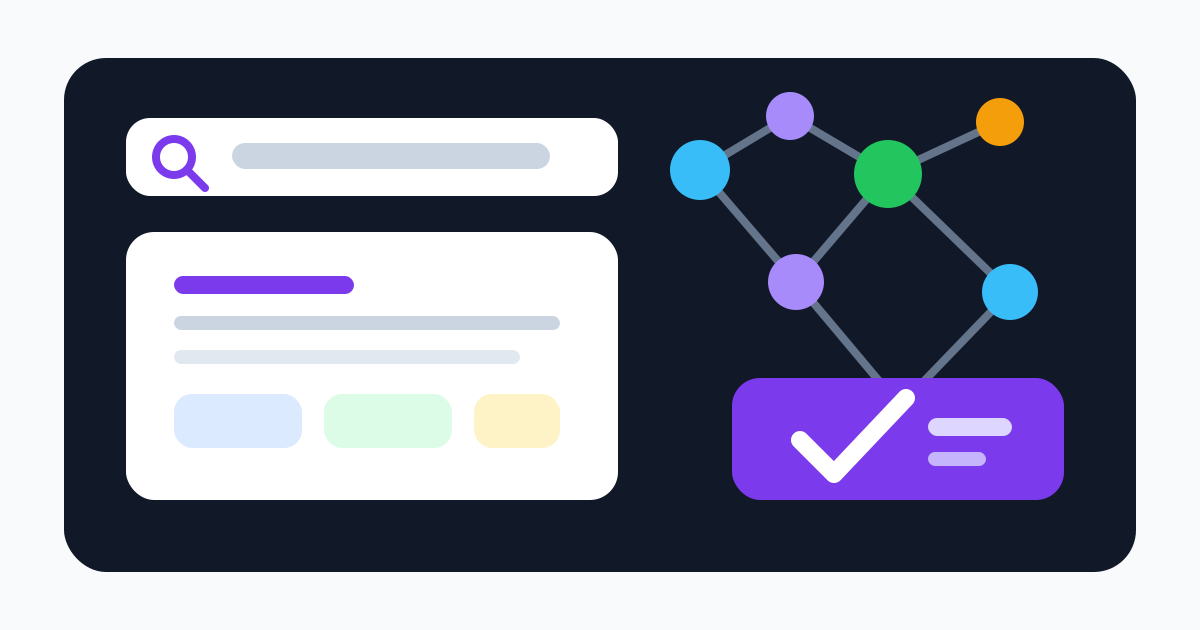
Consensus is an academic search and evidence-synthesis product. A user asks a research question, searches papers, reviews paper cards and filters, and can use Pro or Deep modes to receive a broader sourced synthesis. Study Snapshots expose structured details such as methodology, sample size, and study duration when available.
The product is designed to make scientific research easier to explore, not to certify a claim as true. A real citation is better than an invented citation, but the cited paper may be weak, irrelevant, retracted, non-representative, or described incorrectly.
Papers, Pro, and Deep reviews
Papers search is the broad discovery layer. Pro messages synthesize up to a documented set of papers for a question, while Deep reviews search and organize a larger evidence set with higher monthly allowances on Deep plans. Use filters for date, study type, population, journal, or other supported dimensions rather than accepting the default result set as complete.
Write the question with a clear population, exposure or intervention, comparator, outcome, and time frame. Compare results with a known bibliography. Search synonyms, earlier terminology, negative phrasing, and adjacent disciplines. If one omitted paper would change the conclusion, the workflow needs a formal database strategy beyond a single interface.
Consensus Meter can visualize support or disagreement for suitable yes-or-no questions. It should be read as a model-generated summary of the retrieved set, not a vote of all scientific knowledge. Studies differ in design, sample, bias, outcome, and weight; ten small observational papers do not automatically outweigh one strong trial.
Verify every cited answer
Open the cited paper and locate the exact passage. Confirm whether Consensus had the abstract or full text, then check population, intervention, comparator, outcome, design, sample size, date, effect estimate, uncertainty, limitation, and funding. A conclusion from mice, a subgroup, or a surrogate outcome may not answer a broad human question.
Check corrections, expressions of concern, and retractions. Separate a paper's own result from a sentence in its introduction that merely cites another paper. Preserve the query, filters, result date, selected papers, exported citations, and the final human interpretation.
For clinical, legal, financial, safety, or policy decisions, Consensus should support qualified review rather than replace it. Do not transform a generated paragraph into advice without the required professional process.
ChatGPT App and data route
Consensus provides a ChatGPT App that can search its literature corpus from ChatGPT. Current help documentation gives different monthly search allowances and result counts for no-account, Free, Pro, and Deep or Teams users during the beta period.
This path involves both the Consensus account and the applicable ChatGPT plan and agreement. Review what query is passed to Consensus, what remains in the ChatGPT conversation, how each service logs or deletes data, and who controls the connected account. Do not assume a search run inside another interface has identical retention and support behavior to the Consensus website.
Current pricing
Consensus subscription documentation currently lists Free at $0 with unlimited Papers searches, 15 Pro messages, three Deep reviews, and ten Study Snapshots per month.
Pro is listed at $20 monthly or $144 annually, equivalent to $12 per month, with unlimited Pro messages, 15 Deep reviews, and unlimited Study Snapshots. Deep is listed at $65 monthly or $540 annually, equivalent to $45 per month, and expands Deep reviews to 200 per month. Teams is custom by size and currently includes Pro features plus 50 Deep reviews per user, management, and centralized billing. Enterprise is custom for larger institutions.
Annual effective rates are not flexible monthly prices. Model Deep reviews, Pro questions, ChatGPT App searches, seats, training, library or account integration, and any custom privacy requirement. Refund windows differ by billing type and region under current help documentation.
Privacy, query logs, and training
Consensus's security documentation states that user data is never used to train its own or third-party AI models. It says the service stores anonymized query text by default to understand product use, without tying queries to an individual identity in that system.
Anonymized is not the same as harmless. A rare disease, unpublished molecule, client name, acquisition target, or detailed research hypothesis can be identifying from content alone. Consensus documents organization options to keep queries separate, delete them immediately, or avoid logging under a custom security arrangement. Obtain that commitment before sensitive use.
Review the May 15, 2026 privacy policy, organization contract, retention, support access, deletion, subprocessors, international transfers, and the exact data route. Use public or synthetic questions during evaluation.
Who should choose Consensus?
Consensus is a useful shortlist for people who want to ask an evidence-oriented question and quickly inspect relevant papers, structured study information, and a sourced synthesis. It is especially practical for early exploration and for identifying what must be read next.
Choose Elicit for evidence tables, extraction, reports, and a dedicated systematic-review workflow. Choose Scite for citation context and reference checking. Choose ResearchRabbit for collection-led discovery and citation-map exploration. The AI research and data analysis category explains how to test recall, grounding, privacy, and total verification time.
Visit Consensus