What Scite is
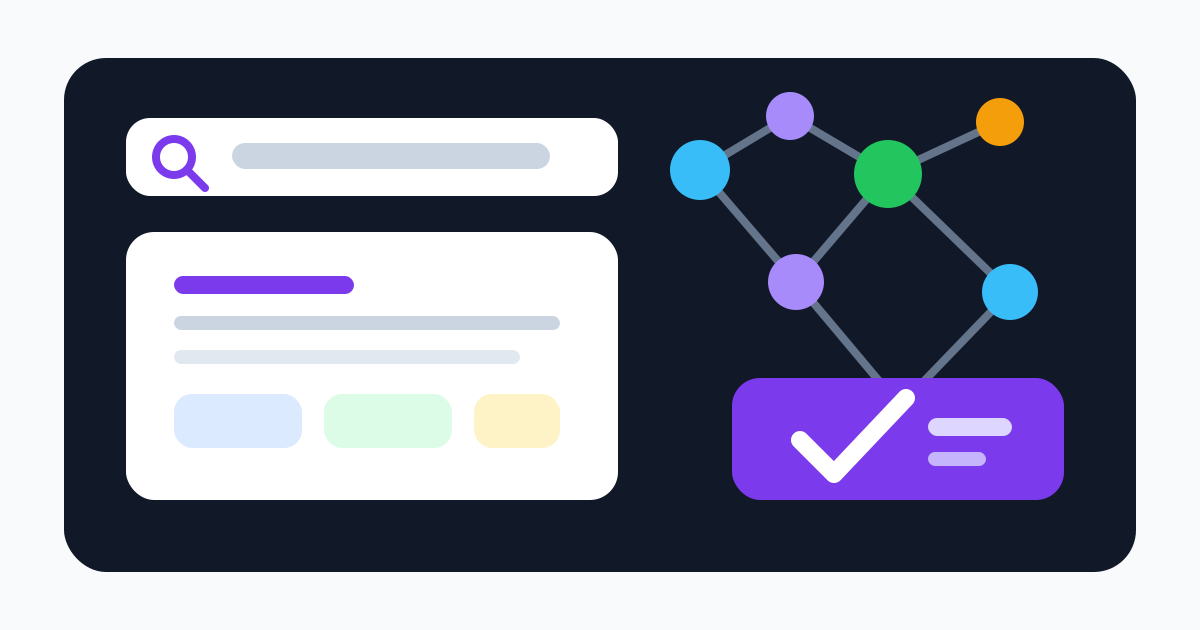
Scite is an academic search and citation-intelligence platform, now part of Research Solutions. It indexes publications and the statements that cite them, then uses Smart Citations to label citation contexts as supporting, contrasting, mentioning, or unclassified.
The important artifact is the citation passage, not the colored label. Seeing what a later paper actually wrote can be much more informative than a raw citation count. The classification remains a model output over a local statement and must not be turned into a universal truth or paper-quality score.
Smart Citations and citation context
Start with a paper, DOI, author, topic, or claim. Review the citing passage, section, publication date, relationship, and whether the citing work is independent. Open both the source and target papers. A sentence can support one narrow result while disagreeing with a broader interpretation.
Counts need context. One citing paper can contain multiple citation statements, self-citations differ from independent replication, and a “mentioning” label is not negative evidence. Contrasting research may use another population, measurement, intervention, or time horizon. Unclassified does not mean neutral or irrelevant.
Scite displays model confidence for classifications. Confidence is not probability that the scientific claim is correct. Sample high-impact labels, check errors, and preserve the exact citation text used in an evidence decision.
Assistant, search, and Reference Check
Scite Assistant answers questions with paper references. Search can cover publication metadata, full text, and citation statements with filters. Reference Check can inspect a manuscript's bibliography against Scite data, helping reveal editorial notices and how references have been cited.
Use these as review accelerators. Assistant can still miss papers or misstate a source. Reference Check cannot determine whether a citation belongs in the sentence, whether the author represented it fairly, or whether an uncatalogued correction exists. Read the original methods, results, limitations, and notice history.
Scite's official site currently describes coverage across hundreds of millions of sources and more than a billion citation statements, including publisher partnerships. Coverage is not uniform full-text access. Record whether a result came from metadata, abstract, citation snippet, licensed text, or an open article.
MCP and API access
Scite publishes MCP connectivity for compatible AI clients. The MCP can search literature, inspect Smart Citation data, and ground an external assistant in Scite sources. Interactive integrations use OAuth; account and Premium requirements can depend on the access route.
The API exposes papers, tallies, citation graphs, search, Reference Check, and other licensed datasets. Official API documentation says commercial or research search use requires a separate license agreement not covered by an individual plan. Server-to-server credentials must be requested.
Connecting Scite to another AI service creates a second data route. Review what the client sends, which Scite response returns, what each service logs, account revocation, OAuth scope, retention, and the rights attached to licensed publisher content. Do not place API credentials in prompts or client-side code.
Pricing and procurement
Scite pricing should be checked in the active account for current individual access, trials, Premium capabilities, and renewal. The public site also offers organization demos, while API and higher-volume data licensing require sales contact.
Price the complete workflow: individual or institutional seats, Assistant use, Reference Check, dashboards, alerts, MCP, API queries, publisher-content rights, exports, training, and support. A personal Premium subscription does not automatically grant the right to embed Scite search in a commercial product.
Save the pricing and license terms shown at checkout. During this review, Scite's public pages were accessible for product and technical evidence, but detailed self-serve pricing was not consistently retrievable, so a precise current price should not be inferred from older third-party pages.
Privacy, ownership, and evidence use
Research queries can reveal unpublished hypotheses, drug targets, legal disputes, investment decisions, or client work. Use public topics during evaluation and review the current privacy policy, terms, institutional contract, subprocessors, retention, deletion, support access, and connected-client behavior before sensitive use.
Publisher agreements give Scite access to content under defined rights. A user who can view a citation context or full-text result does not automatically receive redistribution rights. Keep excerpts short, preserve attribution, and follow the license that controls the source.
If a classification influences publication, safety, policy, or funding, record the Scite result date, passage, target and citing DOI, model label, confidence, reviewer, and final human interpretation. Recheck because papers, notices, and classifications can change.
Who should choose Scite?
Scite is a strong shortlist when the central question is not only “Who cited this?” but “What did later work say when it cited this?” It can strengthen literature exploration, reference review, and evidence-aware AI workflows.
Choose Consensus for question-led multi-paper synthesis and Deep reviews. Choose Elicit for extraction tables and systematic-review workflows. Choose ResearchRabbit for visual, collection-led discovery. The AI research and data analysis category gives a shared coverage, verification, privacy, and licensing checklist.
Visit Scite