What is DataRobot?
DataRobot is an enterprise platform for developing, delivering, and governing AI systems. Its historical strength is automated machine learning for predictive tasks such as classification, regression, time series, anomaly detection, and clustering. The current platform also supports generative AI and agentic workflows, external or custom models, retrieval components, evaluation, deployment, monitoring, and applications.
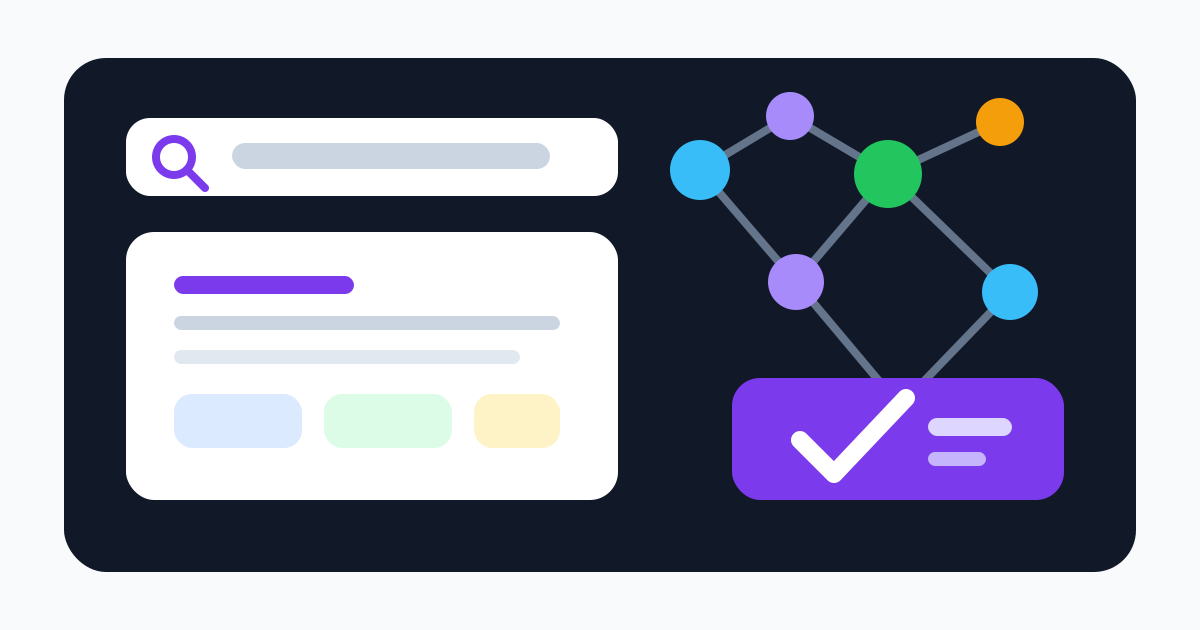
The official platform overview organizes work into development, delivery, and governance. Workbench contains experiments and use cases; Registry packages assets with metadata and evidence; Console monitors deployments. A registered model can be deployed to DataRobot or external prediction infrastructure, and custom models can follow the same lifecycle.
This breadth is useful for organizations standardizing many AI projects. It also means DataRobot is not a one-click answer generator. Successful adoption requires data engineering, domain expertise, ML engineering, infrastructure, security, model risk, and business ownership.
Predictive AI and AutoML
For predictive projects, AutoML can test data transformations, algorithms, blueprints, and hyperparameters, then compare models using selected metrics. Time-series and unsupervised workflows add their own assumptions and validation. A leaderboard accelerates experimentation but does not decide whether the target is meaningful, leakage-free, fair, or causally interpretable.
Before modeling, document population, prediction time, target definition, exclusions, missingness, sampling, labels, and business action. Split data in a way that reflects production, especially across time, customers, geography, or devices. Test subgroups and failure costs rather than selecting the highest aggregate score.
Automated explanations and compliance documents are evidence aids, not a completed risk review. Domain experts must decide whether features are legitimate, whether proxies create discrimination, and whether a prediction should influence a person. Record the champion model, alternatives, approvals, validation dataset, limitations, and intended-use boundaries.
Generative and agentic AI
DataRobot's GenAI documentation supports experiments with selected LLMs, vector databases, embedding models, libraries, and third-party tools. Teams can compare RAG pipelines, prompts, and components with qualitative and quantitative evaluation, then register and deploy the application with monitoring and governance.
This flexibility helps avoid tying governance to one model provider, but every component adds data and failure paths. Record which model and version received which fields, where embeddings and logs are stored, how retrieved documents are authorized, and what retention applies. Evaluate citation support, retrieval coverage, harmful output, prompt injection, data leakage, latency, cost, and task completion using a representative test set.
Agentic capabilities can execute tools and multi-step workflows. Begin with read-only or sandbox actions, require approval for external messages and material changes, restrict network and credentials, and create rollback. DataRobot documentation labels some agentic and vector capabilities as premium, so enablement and commercial scope should be confirmed.
Deployment, registry, and monitoring
Registry can version DataRobot, custom, and external assets and store metadata, test results, and compliance documentation. Deployments can create prediction endpoints and connect to monitoring in Console. Supported patterns include DataRobot or custom models running on DataRobot prediction servers or external infrastructure.
Monitoring can cover service health, latency, data drift, accuracy where outcomes arrive, and other deployment signals. Drift is an alert, not proof that a model is wrong; a stable distribution is not proof that it remains useful. Define thresholds, alert owners, response times, retraining evidence, rollback, and shutdown criteria before launch.
DataRobot also documents deployment approval policies, importance levels, reviewers, timeouts, and monitoring plans. These controls are optional configurations, not automatic governance. If no approval policy is enabled, a capable user may be able to deploy under ordinary permissions. Test role-based access, separation of duties, emergency changes, audit logs, and model replacement history.
Deployment options and pricing
Official documentation describes managed SaaS, virtual private or single-tenant deployments, and self-managed infrastructure. Self-managed DataRobot runs on Kubernetes and creates customer responsibility for capacity, networking, storage, upgrades, backups, observability, and dependent services. Single-tenant SaaS can reduce shared-environment concerns without transferring all operations to the customer.
The trial FAQ describes a one-time 30-day self-service SaaS trial. Production plans, compute, prediction volume, premium GenAI or agentic capability, support, private environments, and services use enterprise pricing rather than one public rate.
Request a quote with named environments, users, modeling and prediction compute, storage, APIs, premium modules, support, implementation, cloud costs, data egress, overages, and renewal. A trial result built on a small sample does not predict production infrastructure cost.
Security, privacy, and data restrictions
The DataRobot Trust Center describes encryption, role-based access, SSO, API security, penetration testing, certifications, subprocessors, and deployment choices. Exact certifications and controls apply to specified offerings, so verify scope and evidence rather than applying a badge to every architecture.
DataRobot's public personal-data guidance says SaaS agreements restrict certain sensitive data categories. Buyers must compare their dataset against the current MSA, AI Policy, Data Processing Policy, region, subprocessors, and selected deployment. Self-managed does not remove the need to secure data connections, notebooks, model artifacts, logs, endpoints, backups, and administrators.
Document whether DataRobot may collect usage metrics or anonymized metadata, how customer data is deleted after termination, and how external model providers process prompts. Use synthetic or minimized data during evaluation when possible. Never upload regulated or contract-restricted data merely because a technical connector accepts it.
Alternatives and decision guidance
DataRobot is appropriate when an organization needs a governed operating layer across many AI assets. Compare Hex for collaborative data notebooks and analytics, Rows AI for spreadsheet-centered workflows, Julius AI for conversational analysis, or Google Gemini for general productivity and model access rather than a full MLOps platform.
Pilot one predictive and one generative use case through the entire lifecycle: source data, experiment, independent validation, registry, approvals, deployment, monitoring, incident, replacement, and deletion. Measure accountable production value, not the number of models built.
Visit the official DataRobot website