
What Rows AI is
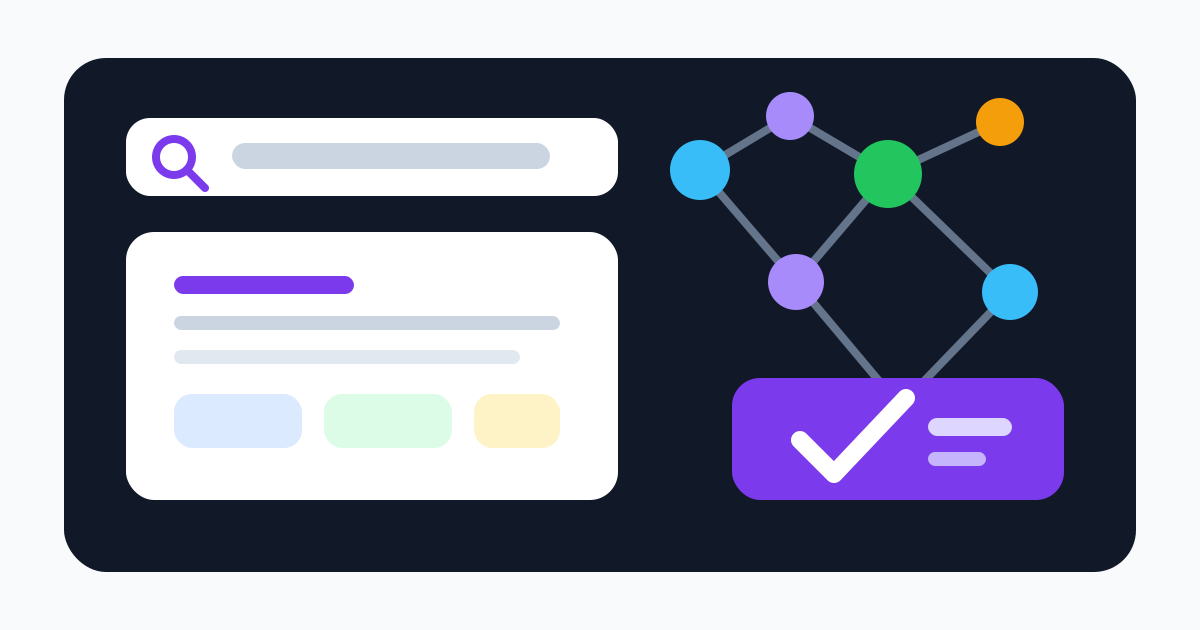
Rows is a spreadsheet product with integrations, automation, sharing, forms, dashboards, and an AI Analyst. The Analyst can inspect tables, create formulas and columns, clean and format cells, merge data, build charts, create models, and research or scrape specified web sources.
It feels like a conversational spreadsheet, but the result remains a spreadsheet model. Every formula, range, data source, refresh, and visual should be reviewable. A natural-language instruction can be ambiguous in exactly the same ways as a manual spreadsheet request.
How AI Analyst reads and changes data
Rows documentation says the Analyst infers dataset context from headers, a sample of up to five rows, and basic statistics. Sampling reduces transmitted data but can hide rare categories, late-period changes, missing-value patterns, and edge cases.
Use explicit prompts that name the table, columns, aggregation, filter, unit, and desired output. Ask the Analyst to show the formula or transformation. Reconcile totals before accepting a chart or derived column. Check copied formulas at the first, middle, last, blank, and exceptional rows.
Rows creates a checkpoint after every three prompts or when the Analyst performs more than three consecutive actions. Current documentation says a spreadsheet stores up to 50 checkpoints for seven days. Checkpoints help recovery but are not a durable audit or backup. Export important versions separately.
Integrations, enrichment, and automation
Rows can import data from business services and use spreadsheet functions or AI to classify, extract, summarize, translate, enrich, and calculate. Pro increases integration accounts, automation frequency, file size, API volume, history, guests, and unbranded embeds.
Use dedicated credentials with the minimum scopes. Separate an imported source table from reviewed output. Avoid overwriting source identifiers or evidence with generated labels. For scheduled refreshes, log source time, row count, schema changes, errors, and last successful run.
AI enrichment can multiply cost and error across many rows. Test a sample with known answers, add a confidence or review field, preserve the source URL, and stop the job if error or empty-result rates rise.
Web research and scraping
The current AI Analyst can research the web and scrape specified URLs. Official guidance recommends naming the pages and fields rather than asking it to browse the entire web. This makes provenance easier to retain.
Public visibility is not permission to collect, republish, or enrich personal information. Review site terms, robots expectations, licenses, rate limits, copyright, privacy law, and the lawful basis for people data. Record URL, access date, extracted text, transformation, and correction route.
Search results and pages change. A price, executive, financial figure, or policy should include a source and verification date. Do not allow a generated cell to overwrite the raw capture.
Current pricing and AI Tasks
Rows pricing currently lists Free at $0 with five AI Tasks per month. Plus is $8 per user monthly or $6 effective on annual billing, with 200 AI Tasks, ten integration accounts, ten guests, 5 MB file imports, and 30-day history.
Pro is $79 per month plus $8 per user monthly, or $59 plus $6 per user effective annually. It includes 1,000 AI Tasks, 100 integration accounts, up to 200 guests, more frequent automation, 100 MB imports, two-year history, unbranded embeds, and higher API limits. Enterprise is custom with high-volume and security capabilities.
Each Analyst message counts as a task. Table- or chart-triggered Analyst actions and AI Vision files also consume tasks; large files can consume more than one. AI calls through the API consume an API call plus the corresponding tasks. Cell enrichment has separate large-volume allowances. Model all meters with a representative workbook.
Privacy and model context
Rows says the AI Analyst does not use customer data to train models that could benefit other users and transmits the minimum context needed. Its documentation identifies headers, up to five sample rows, and basic statistics as model context.
That sample may include names, emails, financial values, health details, or confidential text. Minimize and mask before prompting. Review the current privacy policy, selected model providers, subprocessors, retention, region, deletion, integrations, shared links, embeds, and support access.
Rows has joined Superhuman according to current product pages. Procurement should confirm the current contracting entity, policies, subprocessors, and transition terms rather than relying on older assumptions.
Who should choose Rows AI?
Rows AI is a strong shortlist for business teams that want AI assistance in a familiar tabular environment, combined with operational integrations and polished sharing. It works best when spreadsheet controls and review remain visible.
Choose Julius AI for notebook-backed analysis and broader code or report artifacts. Choose Hex for collaborative SQL/Python notebooks, semantic models, and governed data apps. Choose ChatPDF for focused document questions rather than spreadsheet operations. The AI research and data analysis category provides a shared formula, source, permission, privacy, and cost test.
Visit Rows AI