
What is Duck.ai?
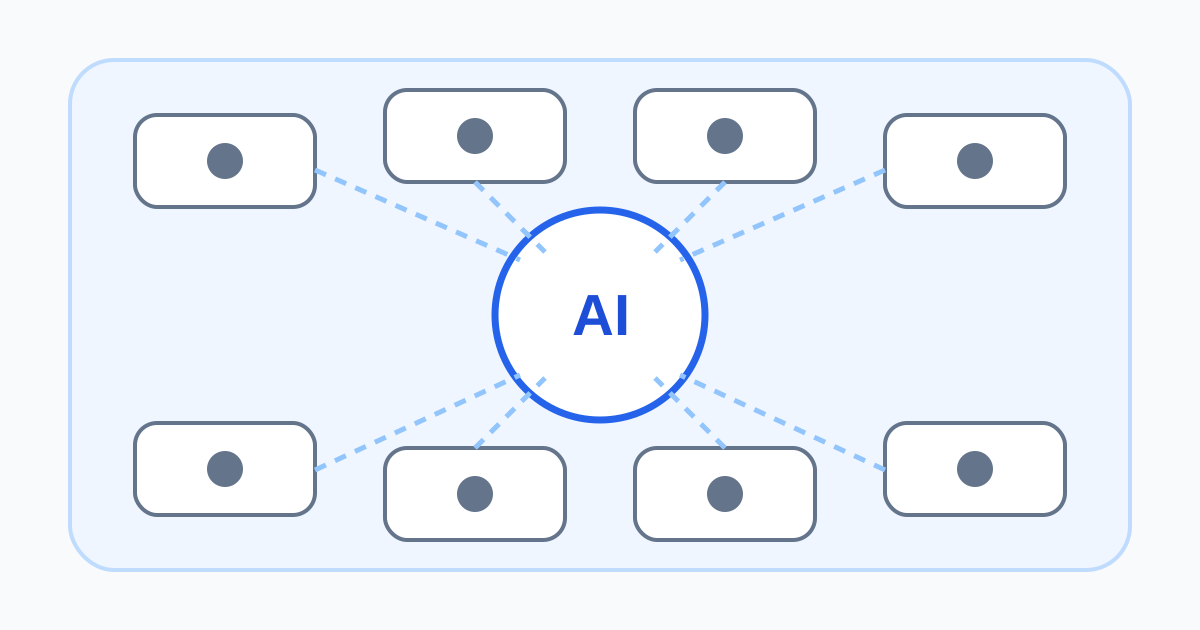
Duck.ai is DuckDuckGo's optional, multi-model AI chat service. It sits at duck.ai, appears in the DuckDuckGo browser, and can be opened from search results for follow-up questions. The practical distinction is not a proprietary DuckDuckGo foundation model. DuckDuckGo acts as a privacy layer between the user and third-party models, removes identifying request metadata, routes the prompt, and returns the provider's response.
The free selection checked August 9, 2026 includes Anthropic Claude 4.5 Haiku, Mistral Small 4, OpenAI GPT-5.4 nano and mini, plus gpt-oss-120b and Gemma 4 31B hosted by Tinfoil. Plus subscribers add GPT-5.4 and Claude Sonnet 4.6. Pro adds Claude Opus 4.8, higher reasoning effort, and twice the Plus usage limits. This catalog changes over time, so choose based on the model shown in the live selector and its session privacy notice, not an old review.
Duck.ai handles general questions, drafting, rewriting, summarization, file and image input, image generation, voice chat, and dictation where available. Different models have different context, media, reasoning, language, and response characteristics. DuckDuckGo says it does not filter or modify model responses. That preserves provider output but also means a response may be inaccurate, offensive, biased, unsafe, or unsupported.
What “private AI chat” means here
Before a text prompt reaches a model provider, DuckDuckGo removes metadata such as the user's IP address, so the request appears to come from DuckDuckGo. Its agreements prohibit model training on Duck.ai conversations and require zero data retention for the listed integrations. The detailed help page is valuable because it also discloses exceptions.
OpenAI and Anthropic may keep prompt-cache material in short-term memory for up to one hour, without writing it to disk. Anthropic may retain data where legally required or needed to combat malicious use. Uploaded images and files are checked anonymously for child sexual abuse material by a third-party moderation provider and sometimes the model provider; flagged material is retained and reported. Tinfoil-hosted models run in a trusted execution environment and are labeled zero provider visibility, offering a stronger technical boundary for those sessions.
DuckDuckGo says it does not store text prompts for ordinary chats. To understand aggregate usage, its servers temporarily compute an embedding, match it to a representative prompt from an open-source dataset, discard the original embedding from memory, and retain the representative prompt plus anonymous statistics. If a user explicitly submits a conversation with feedback, DuckDuckGo can store and review it.
These protections reduce linkage and training risk, but they cannot remove personal or confidential information typed inside the prompt itself. A provider can process what is sent even if it does not know the sender's IP. Do not paste secrets, regulated records, unpublished source code, credentials, or third-party personal data without authorization and a suitable risk assessment.
Chat history, files, and voice
Recent chats are saved locally on the device by default. Behavior in third-party browsers depends on browser storage rules; Safari, for example, may remove local history after inactivity, while other browsers may keep it indefinitely. Duck.ai has its own Fire Button and pinning behavior, so clearing ordinary browser data does not always mean every Duck.ai conversation is deleted.
Optional Sync & Backup puts chat history on cloud infrastructure in end-to-end encrypted form. DuckDuckGo says the master decryption key remains on the user's devices and it cannot read synced conversations. Synced chats are automatically removed after 18 months without access. Losing all linked devices and the recovery material can also mean losing access, so treat the feature like any client-controlled encryption system.
Voice chat sends a live encrypted audio stream through a relay to OpenAI; dictation records locally for up to five minutes and sends the audio for transcription. DuckDuckGo and OpenAI say they do not retain voice recordings after the session. A voice is a biometric identifier, however, and the provider necessarily processes it in real time. Text transcripts follow the selected local-history setting.
Free, Plus, and Pro pricing
The free version has a daily usage limit, but DuckDuckGo does not publish it as a guaranteed fixed number of messages. Anonymous enforcement can cause a user on a VPN or cellular network to encounter a shared limit sooner. Plus and Pro use daily and weekly pools; Pro offers twice the Plus limit. Current consumption appears in settings.
US pricing checked August 9, 2026 is $9.99 monthly or $99.99 yearly for Plus and $19.99 monthly or $199.99 yearly for Pro. The subscription also bundles VPN, Personal Information Removal, and Identity Theft Restoration, so this is not an AI-only price comparison. Plus includes advanced GPT and Claude Sonnet access; Pro adds Opus and higher reasoning. Prices differ by supported country and include VAT in the published international table.
Verdict
Duck.ai is a compelling option for casual and individual multi-model chat when minimizing account linkage, provider-visible metadata, training use, and remote history is a priority. Its privacy documentation is unusually concrete and makes model-specific exceptions visible. It is less suitable as a managed organizational platform because capacity is not guaranteed, the model roster changes, and enterprise collaboration, API, governance, and audit capabilities are not the product's focus.
Test it with non-sensitive, representative tasks. Compare factual support, instruction following, language quality, refusal behavior, and quota reliability across the models you would actually use. Verify important output against primary sources. Privacy improves the data path; it does not turn an AI answer into fact or make disclosure consequence-free.