What is Meta AI?
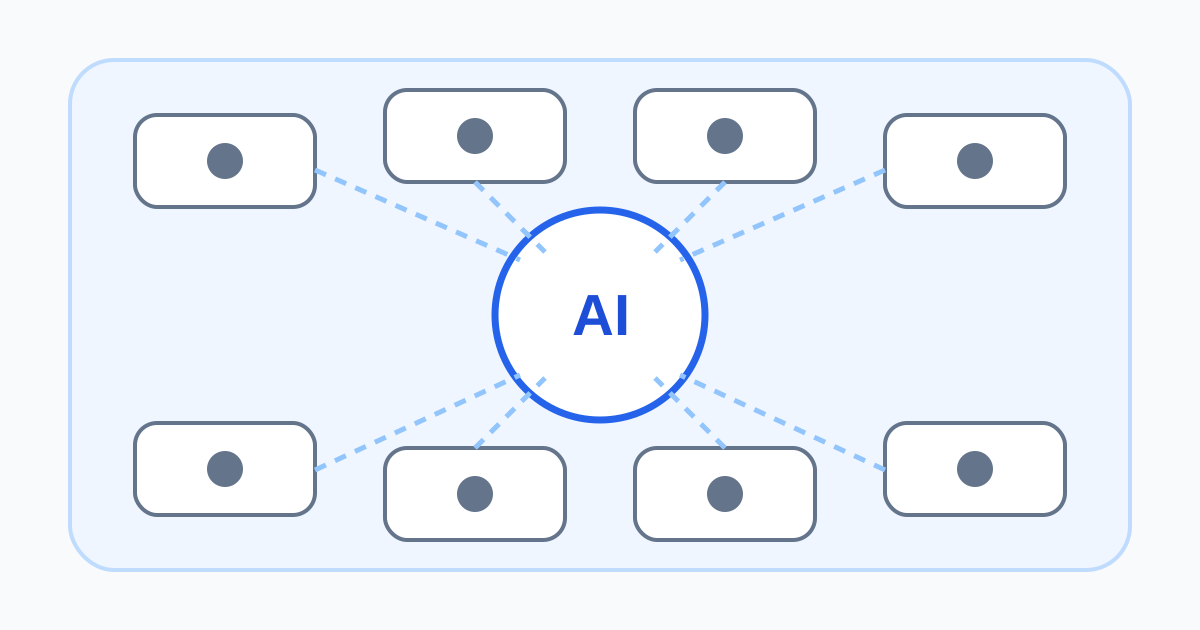
Meta AI is Meta's consumer-facing general assistant. It appears on the web and across products such as Facebook, Instagram, Messenger, WhatsApp, the Meta AI mobile app, and supported AI glasses, although the exact experience varies by country and device. It can answer questions, help plan activities, surface web and social information, generate or edit images, and support voice conversations. Newer versions also add multimodal understanding and task-oriented features that can work with connected services.
The product's main distinction is ecosystem context. A standalone assistant usually begins with only the current conversation and whatever files or links a user supplies. Meta AI can, where the feature is available and the user has enabled the relevant account connections, draw on information and activity within Meta's products to make answers more personal. That can be convenient for discovery and everyday planning, but it also makes account settings and privacy policies more important to the buying—or, in this case, adoption—decision.
Meta changes the assistant quickly. Its official product update describes current reasoning, multimodal, voice, image, recommendation, and agent-style capabilities, but individual features may roll out gradually. Treat a feature announcement as evidence of direction, not proof that every account can use it today.
Core Meta AI workflows
For general questions and discovery, Meta AI can combine conversational answers with information from the web and public content in Meta's ecosystem. This is useful when a user wants ideas, an initial comparison, travel inspiration, shopping discovery, or a quick explanation without moving between several apps. The output still needs verification. Open linked sources, distinguish public posts from authoritative references, and check whether a recommendation is influenced by location or personalized context.
Creative workflows include image generation and editing through text or voice. This can speed up mood boards, social concepts, invitations, casual illustrations, and early visual drafts. Users should still check the applicable terms, avoid uploading material they do not have rights to use, and review generated details before publishing. Image tools can produce convincing but inaccurate text, logos, products, or people.
Voice and multimodal features make Meta AI relevant when typing is inconvenient. Supported experiences can handle natural conversation and, on eligible devices, interpret what the camera sees. That may help with objects, places, visual comparisons, or hands-free questions. Availability is especially sensitive to device, language, and country, so confirm it on the exact surface you intend to use.
Meta is also moving the assistant toward actions and connected workflows. These can include planning, slides, research, and connections to services such as email or calendars in selected rollouts. Before granting a connection, review what data the integration can access, what actions require confirmation, and how to revoke the permission.
Pricing and availability
Meta currently positions the consumer Meta AI experience as free in supported markets rather than as a separate paid subscription. That does not mean access is universal or unlimited. A feature may require a Meta account, a particular app version, a supported language, a compatible device, or a country included in the current rollout.
There is no single permanent feature table that applies across meta.ai, WhatsApp, Instagram, Facebook, Messenger, the standalone app, and smart glasses. Evaluate the surface you actually plan to use. A capability visible in a Meta announcement may be experimental, region-limited, or unavailable to a managed or age-restricted account.
Privacy and data considerations
Meta's generative AI privacy information explains that the company may use certain public information and interactions with AI features to develop and improve generative AI models, with legal bases and objection rights that can differ by region. The AI terms also describe prompts, outputs, feedback, and the relationship to Meta's broader privacy policy.
This matters because Meta AI can sit inside products that already contain identity, social, messaging, media, and engagement data. Personalization may improve relevance, but it also increases the amount of context that can shape an answer. Check Accounts Center connections, AI history, personalization settings, and any available private or incognito mode before entering information you would not want associated with your account.
Do not assume that a private chat is appropriate for confidential corporate, legal, medical, or client information. Product privacy controls and an organization's contractual requirements are separate questions. Remove unnecessary identifiers and use an approved business product when formal data-processing terms are required.
Strengths and limitations
Meta AI's strongest advantage is reach. People already using Meta products can encounter the assistant without adopting a separate workflow, and continuity between web, mobile, messaging, and glasses can make casual assistance convenient. Its mixture of social discovery, multimodal input, voice, and images also differs from assistants focused mainly on documents or coding.
The same ecosystem creates its largest trade-off. Results may depend on account context, public social content, location, and staged product rollouts. That makes screenshots and tutorials age quickly. Users also need to separate engaging recommendations from well-supported evidence. A confident answer grounded in popular public posts is not automatically an expert or primary-source conclusion.
Who should choose Meta AI?
Meta AI is a practical option for people who already use Meta's apps and want lightweight assistance, creative tools, discovery, or voice interaction without purchasing another consumer subscription. It is particularly attractive when social context or continuity with supported glasses matters.
Choose ChatGPT or Claude when document-centered work and a more independent workspace are priorities, Gemini when Google ecosystem integration is central, or Perplexity when citation-led web research is the main job. The right choice depends less on a model announcement and more on where your information already lives, which privacy controls you require, and whether the exact feature is available in your market.
Visit the official Meta AI website