
What is MindStudio?
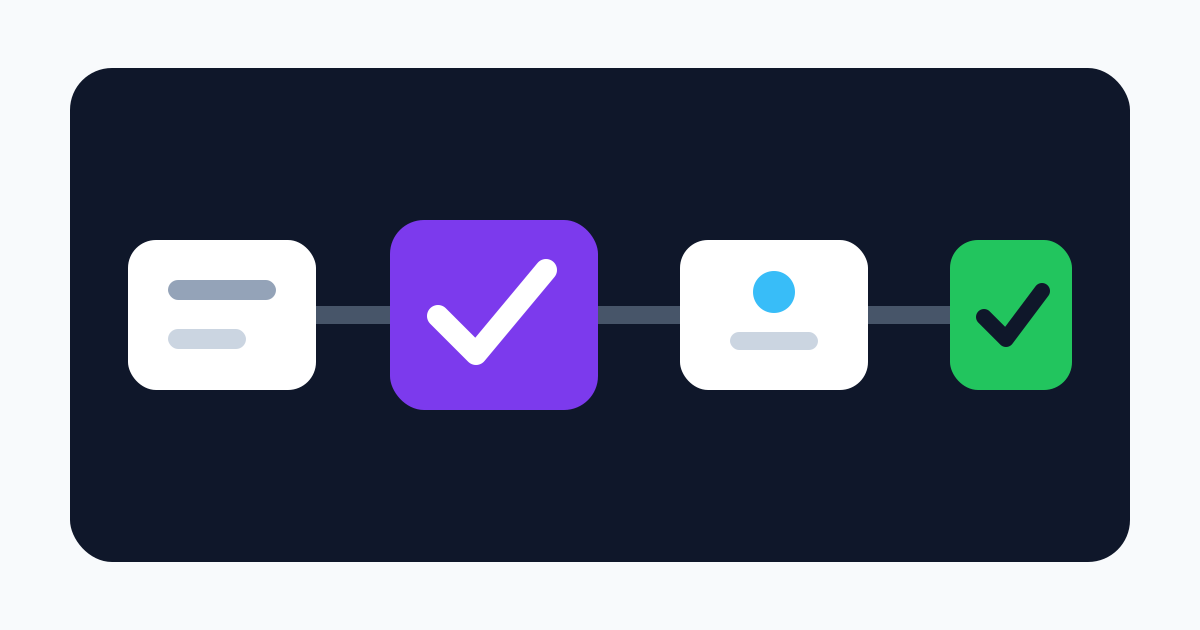
MindStudio is a visual platform for building, running, and deploying AI agents. A builder can combine instructions, branching, data transformations, model calls, files, web content, integrations, and JavaScript or Python without first creating a complete orchestration service. Agents can be distributed through links, embeds, APIs, and other surfaces, while a browser extension can run an agent against the page a user is viewing.
The vendor promotes access to more than 200 models. That breadth is useful for comparing cost, latency, modality, context length, and output quality, but the number is not a durable promise that every model offers the same tools, regions, safety controls, or data treatment. Production teams should approve model-provider combinations rather than allowing any listed model to receive any data.
How the builder fits together
A MindStudio workflow can turn an input into a sequence of prompts, conditions, integrations, code, and outputs. Templates speed up first drafts, and custom functions cover cases that a visual block cannot. The important design question is where probabilistic reasoning ends and deterministic validation begins.
Use a model to classify or draft when an error is reversible. Use code, schemas, allowlists, server-side authorization, and human approval where an agent changes money, access, records, or public content. Credentials should be scoped to the smallest resource and operation. Treat text retrieved from websites, files, email, and connected systems as untrusted input because it can contain prompt injection or instructions that conflict with the operator's intent.
The browser extension deserves a precise reading. MindStudio's terms say the extension receives the content of the current webpage when the user explicitly interacts with it, rather than collecting general browsing history. That is a narrower data path, but the current page can still contain private messages, customer records, financial data, or unpublished documents. Users need a visible rule for which sites and data classes may be processed.
Pricing: runs are not model usage
As checked on August 9, 2026, the official Free plan included one agent and 1,000 runs per month, plus usage. Individual cost $20 per month or an advertised $16 per month when billed annually, with unlimited agents and unlimited runs, also plus usage. Business pricing was custom and added team controls such as permissions, SSO, audit logs, budgets, and flexible deployment including self-hosting.
A run means one execution of an agent, not one model token or one workflow step. An agent can make multiple model calls, process a long document, retry an integration, or execute custom code inside one run. MindStudio says model use is billed per token without markup and supports bring your own keys. “No markup” is a vendor statement, not a total-cost guarantee: provider minimums, retrieval, API subscriptions, storage, compute, failures, and operational labor still matter.
Before buying, replay a representative workload and measure cost per successful outcome. Include long inputs, retries, timeouts, peak concurrency, external API charges, and human review. Put limits on tokens, loop count, execution time, and monthly spend. Test what users see when a key expires, a provider rate-limits, a model is retired, or an integration returns malformed data.
Privacy and deployment choices
MindStudio's privacy policy states that user data is not shared with model providers for training and specifically says Google Workspace API data is not used for generalized AI training. This is helpful vendor policy, but an agent's full data path can also include a model provider selected by the builder, user-supplied keys, third-party APIs, websites, and custom endpoints. BYOK moves billing and part of the contractual relationship to the customer's provider account; it does not automatically keep prompts inside MindStudio or improve the provider's retention terms.
Business materials advertise SSO, roles, audit logs, budgets, flexible deployment, and self-hosting. Buyers should confirm which components self-host, which control plane remains vendor-operated, how model traffic routes, where logs and secrets live, and how deletion and backups work. Also verify subprocessors, residency, incident terms, and whether audit events cover agent edits, credential use, deployments, and data access.
Verdict
MindStudio is attractive for rapidly assembling focused AI workflows across models and delivery channels. Its practical advantage is orchestration speed, not the removal of engineering or governance. The safest adoption starts with a narrow, measurable task; an approved model and data policy; read-only or reversible tools; a human-reviewed test set; and explicit spend and execution limits. Move to higher-impact actions only after logs and real outcomes demonstrate that the complete workflow—not merely its best demo—behaves reliably.