What is SmythOS?
SmythOS is a platform for designing and deploying AI agents that combine language models, APIs, data sources, retrieval, and executable logic. Its visual Agent Studio is intended to make multi-step behavior easier to assemble and inspect, while an AI-assisted builder can turn a written requirement into an initial workflow. Agents can then be tested, scheduled, called through APIs, embedded in a website, exposed as MCP servers, or exported for other deployment arrangements.
The platform sits between a no-code automation service and a code-first agent framework. It is useful when a workflow needs probabilistic reasoning as well as deterministic integrations. It is less useful when a simple trigger-and-action automation already solves the problem. SmythOS's official product material describes visual composition, a large integration surface, multiple model choices, retrieval, debugging, collaboration, and deployment options; each project should verify what its selected plan actually enables.
Building an agent
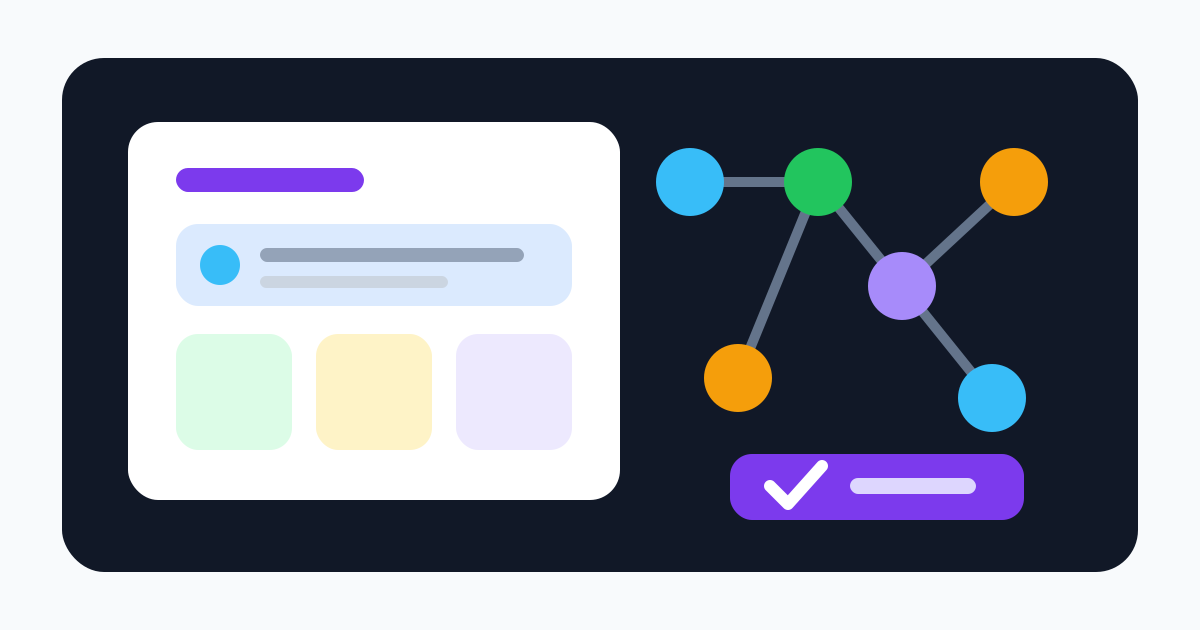
A responsible project starts with a narrow outcome: for example, classify a support request, retrieve the approved policy, draft a proposed reply, and ask a human to send it. In the visual builder, each model, API, code block, data pool, and decision becomes part of a graph. This visibility can help reviewers understand the main path, but a diagram is not proof that the runtime will behave safely.
Create test fixtures for normal inputs, missing fields, malformed data, contradictory sources, model refusal, timeouts, rate limits, and hostile instructions. Define which steps may retry and which should stop. If an agent can send email, update a CRM, purchase something, or publish content, require explicit validation and ideally approval before the action. Store credentials in the platform's secret mechanisms and grant the least privilege possible.
Retrieval-augmented agents need curated data pools. Do not upload an undifferentiated archive and assume the agent will always select the right passage. Remove superseded policies, attach dates and ownership, restrict sensitive collections, and test whether citations actually support the answer. A model's fluent response is not evidence of correctness.
SmythOS supports several delivery patterns, including APIs, website chat, bulk work, schedules, and MCP. Export and local deployment can improve infrastructure control, but they also move responsibility for upgrades, observability, access, backups, and incident response to the operator.
Plans and usage pricing
The official pricing documentation distinguishes a free tier for learning, testing, and public agents from paid tiers that add private agents, API and MCP deployment, collaboration, retrieval features, scaling, or enterprise infrastructure. The exact names, prices, included credits, and quotas can change, and the marketing pricing page and documentation may be updated at different times. Confirm the checkout terms before committing.
A subscription is only one layer of cost. SmythOS's billing documentation lists managed-model rates or multipliers, production task execution, runtime, and optional services such as search or scraping. Bring-your-own-model can shift model charges to the external provider rather than eliminate them. Forecast a complete agent run, including branches, retries, retrieval, tool calls, and the volume of scheduled or bulk work. Set billing limits and watch analytics during a controlled pilot.
Privacy and deployment governance
The SmythOS privacy policy applies to services operated by INK Content and describes account, usage, device, payment, support, and service data; providers and legal transfers may be involved. It also states that the company does not sell, rent, or trade email lists for marketing and outlines GDPR and US state privacy rights. That policy should be read alongside the customer agreement and any data-processing addendum.
Model prompts, retrieved documents, and integration payloads can also travel to chosen model providers or third-party APIs. Map each data flow rather than treating “local deployment” or “bring your own model” as a universal privacy guarantee. Determine where logs and exports reside, who can view agent definitions, how long data remains, and how deletion works.
For sensitive operations, evaluate an exported local runtime or enterprise deployment only after confirming feature parity, update procedures, support obligations, licensing, and network dependencies. Public agents should never contain private instructions, secrets, or proprietary data simply because a visual editor makes them easy to assemble.
Who should choose SmythOS?
SmythOS is a strong candidate for developers, automation consultants, and agencies that want to prototype complex agents visually and distribute them through several interfaces. The choice is most compelling when exportability and model choice matter alongside managed convenience.
Compare Dify for an open-source LLM-application stack, Langflow for component-based experimentation, CrewAI for a code-oriented multi-agent framework, or Activepieces for conventional automation with AI steps. Test the same workflow, permissions, failure cases, and monthly workload on each. The best platform is the one the team can operate predictably—not the one with the longest integration list.
Visit the official SmythOS website