
What is Voiceflow?
Voiceflow is a collaborative platform for building customer-facing chat and voice agents. A team can design behavior, connect a knowledge base and external tools, test conversations, publish to web chat or telephony, inspect transcripts, and evaluate outcomes without assembling every lifecycle component separately.
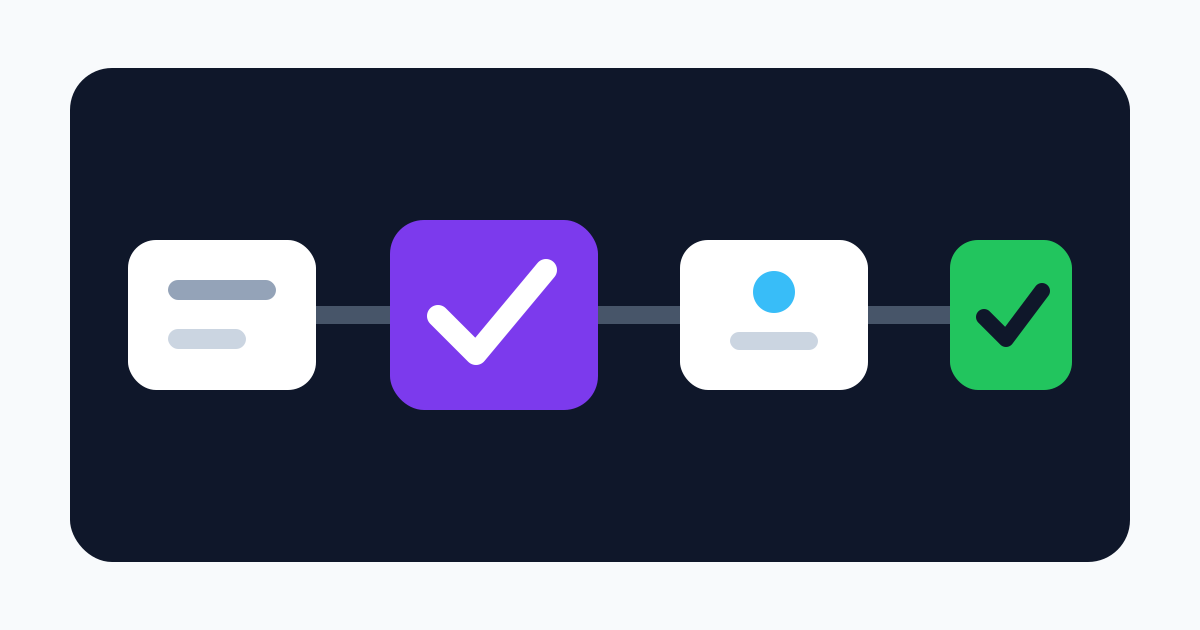
The platform supports two complementary control styles. Playbooks give an agent goals, instructions, tools, and knowledge so it can choose a path dynamically. Workflows encode a defined sequence for predictable steps. A useful production design does not choose one ideology for everything: an agent may use a playbook to understand a request, then enter a workflow for identity checks, refunds, disclosures, or handoff.
Building an agent
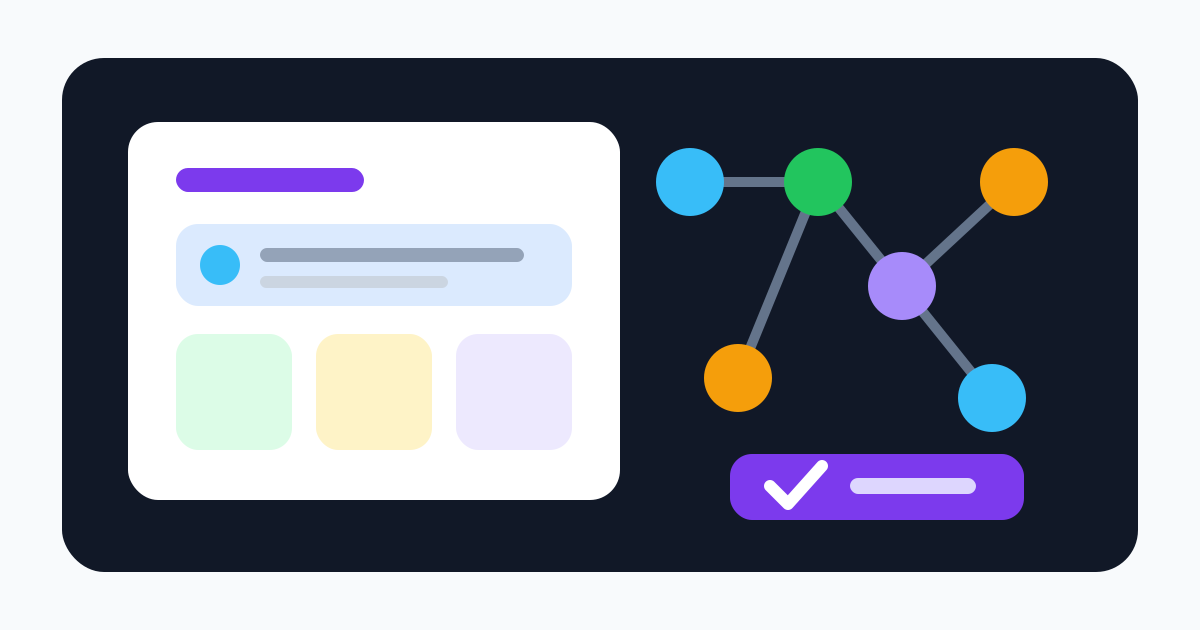
Knowledge sources supply answers from approved material, while tools let the agent call APIs, integrations, or MCP servers. Teams can prototype in a visual builder, use APIs for deeper integration, and test individual paths or complete conversations. Reusable components help standardize behavior across agents, but reuse also propagates mistakes quickly. Version owners, test cases, and change review remain necessary.
Retrieval quality depends on source quality, chunking, freshness, permissions, and whether the answer can actually be supported by the retrieved passage. A confident response is not proof that the knowledge base contained the right evidence. High-risk answers should cite a source, refuse when evidence is weak, or hand off to a person.
External tools raise the stakes. Reading an order is different from canceling one; preparing a refund is different from issuing it. Separate read and write tools, validate arguments on the server, use least-privilege credentials, require confirmation for consequential actions, and make operations idempotent. Never rely on a prompt alone as an authorization boundary.
Deployment, environments, and measurement
Voiceflow can deploy agents to web chat, voice systems, and other channels. Its environment model supports independent draft and live copies, traffic splitting, and rollback. Some resources are still shared at project scope: official environment documentation notes that document contents and integration secrets can be shared, with per-environment overrides available for secrets. Review this carefully before assuming a staging agent is fully isolated from production data.
Transcripts provide full conversational context, metadata, and evaluation results; voice deployments may also retain call recordings. Evaluations can score every transcript and can be applied retroactively. They are useful for triage and trend analysis, not ground truth. A model may misread sarcasm, incorrectly infer resolution, reward a prohibited behavior, or miss a silent failure. Calibrate evaluation prompts against a human-reviewed sample and separately track hard outcomes such as repeat contact, refund errors, escalation, abandonment, and complaints.
Pricing and capacity planning
As checked on August 9, 2026, Voiceflow's public pricing page promoted a free, no-card agency trial but directed business buyers to request pricing. Official billing documentation says an invoice can combine a monthly plan, editor seats, phone numbers, add-ons, and credits. Credits are shared across an organization and reset each billing cycle; model calls, voice, and orchestration consume them. Auto top-up and concurrent-call capacity can add spend, while PII redaction is described as an add-on.
This means “cost per seat” is not enough. Model representative conversations by channel, duration, model, retrieval, tool calls, retries, and escalation. Voice latency or a long call can matter more than editor seats. Set budget alerts and top-up caps, monitor abnormal loops, and test degraded behavior when credits, a model provider, or an integration is unavailable.
Privacy, security, and governance
Voiceflow's official security material reports SOC 2 Type II and ISO 27001:2022 controls and describes GDPR and HIPAA support. Certifications describe a control program; they do not make a particular agent compliant. The customer still decides what data to collect, which providers and integrations receive it, how long it remains, and who can access transcripts.
The terms and DPA place important duties on the customer, including providing end-user notices, establishing a legal basis, managing data-subject rights, and acting as controller for end-user data. Before launch, map the data path across Voiceflow, model vendors, speech services, telephony, analytics, help desks, and custom APIs. Define call-recording consent, sensitive-data suppression, redaction, retention, deletion, access roles, audit review, and incident ownership. Review the current contract and subprocessor list rather than relying only on a marketing badge.
Verdict
Voiceflow is a strong fit when conversational design, agentic reasoning, deterministic processes, deployment, and measurement need to live in one team workspace. The architecture can support disciplined production work, but it does not supply governance automatically. A credible rollout starts with a narrow use case, verified knowledge, low-risk tools, explicit handoff, a representative evaluation set, and a real usage-cost model. Expand autonomy only after customer outcomes—not just model scores—show that the system is safe and useful.