What is Stack AI?
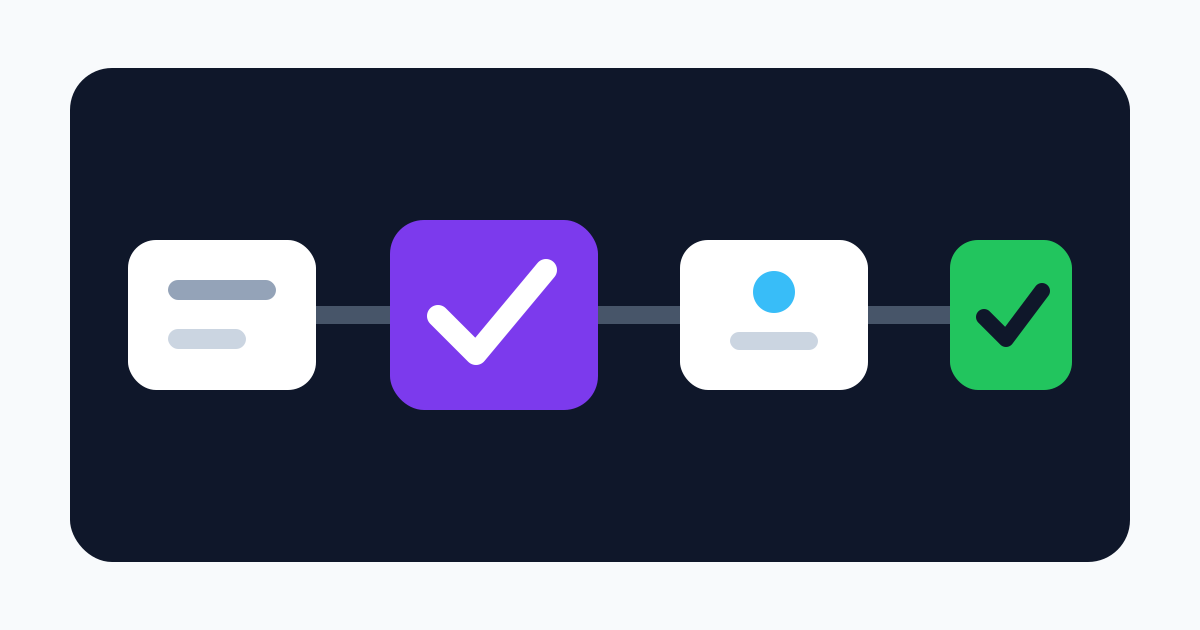
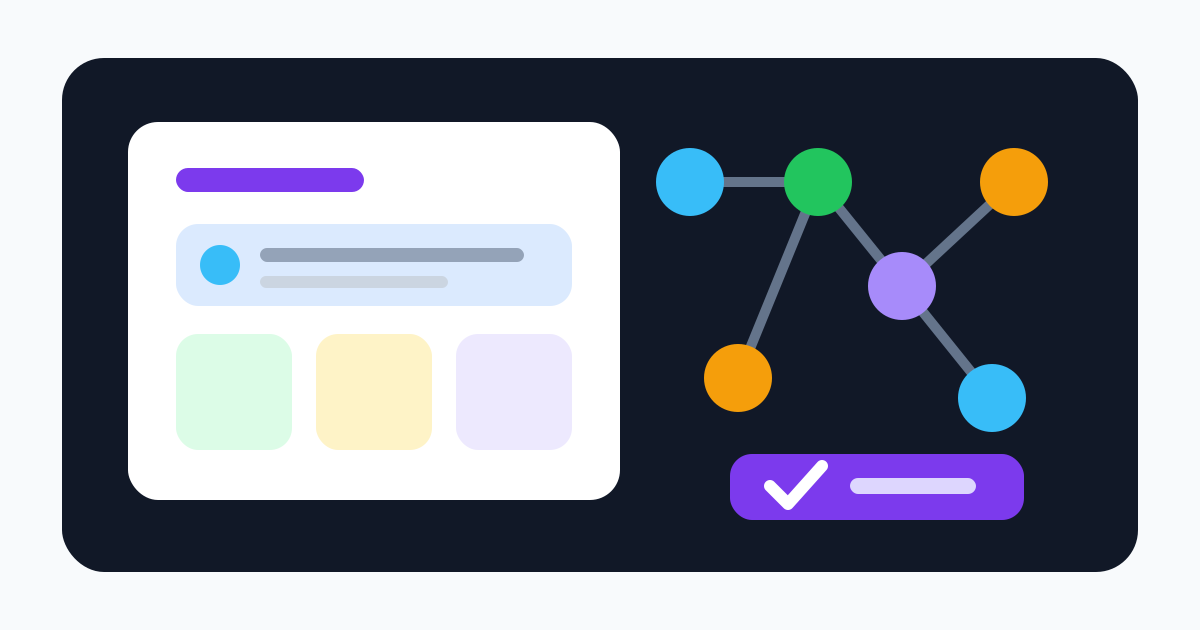
Stack AI is a visual platform for building enterprise AI agents and workflows. Builders connect model, knowledge, input, logic, integration, and output nodes on a two-dimensional canvas. A project can read PDFs, Word documents, presentations, websites, cloud files, or databases; retrieve relevant context; ask one or more models to reason over it; call business systems; and return a result through an interface or API.
This makes the product broader than a chatbot builder. Suitable prototypes include document intake, due-diligence support, policy search, report generation, support triage, data extraction, internal research, and controlled updates to operational systems. Interfaces can include a ChatGPT-style experience, an embedded website assistant, voice or messaging channels, and a custom application calling the API.
The canvas makes a process visible, but it does not make that process safe. Every connector carries permissions. Every retrieved document can contain stale information or prompt injection. Every model can produce unsupported output. Every write action can create a duplicate, disclose information, or change a record incorrectly. Treat a Stack AI project as production software once it touches real data or performs an external action.
Building a production-ready workflow
Begin with one narrow outcome. Define the accepted inputs, authoritative sources, required citations, permitted model and tools, maximum runtime, maximum calls, confidence threshold, prohibited actions, approval points, escalation path, and measurable success criteria. Separate development, test, and production projects, credentials, datasets, and endpoints.
Use the least-privileged connection available. A document-answering agent normally does not need write access to the source repository. A CRM research agent should not be able to delete contacts or change ownership. Put deterministic validation outside the model before an agent sends email, uploads a file, edits a financial record, executes code, or publishes an answer. Add idempotency and duplicate detection where a retry could repeat an action.
Stack AI supports knowledge bases and citations, but retrieval must be evaluated with representative questions. Measure source recall, citation support, refusal when evidence is absent, cross-tenant isolation, freshness, and behavior when a document contains hostile instructions. For document extraction, compare every required field against labeled examples, including scans, tables, missing pages, ambiguous dates, handwritten content, and low-quality files.
Analytics can expose run status, duration, token use, and workflow inputs and outputs. That visibility helps debugging, evaluation, and cost control; it also means logs may contain the same sensitive material as the workflow. Decide who can view or export conversations, what should be redacted, how long logs are retained, and how deletion propagates before processing confidential data.
Models, integrations, and deployment
The platform offers multiple model providers, customer API keys, fallback models, PII filtering, memory, and citations. Its bring-your-own-model documentation says administrators can configure public or private connections, connect local LLMs, enable or disable providers, and disconnect Stack AI's supplied keys so users are limited to approved models configured on their server.
Those controls are valuable for governance, but they do not create a universal private-data path. Trace each project node by node: Stack AI infrastructure, model endpoint, embeddings, vector storage, file parser, integration, analytics, observability, and human support. Record what each system receives, in which region, under which account and contract, for how long, and with which deletion mechanism.
The security page describes four deployment models spanning multi-tenant cloud to air-gapped on-premises, and the pricing page lists dedicated infrastructure, VPC, and on-premises deployment for Enterprise. Do not infer that these options are included by default. Confirm architecture, operational responsibility, upgrades, telemetry, outbound traffic, keys, backups, disaster recovery, incident response, and support access for the exact deployment purchased.
Pricing and cost controls
The current public pricing page lists Free at $0 with 500 runs per month, two projects, one seat, and community support. Enterprise has a custom number of runs and seats, unlimited projects, all features and data loaders, dedicated infrastructure and solution engineers, plus options such as on-premises or VPC deployment, access control, SSO, and compliance support.
The public page does not expose a fixed paid self-service price. Before comparing vendors, obtain a written definition of a run and confirm whether loops, retries, nested agents, evaluations, failed executions, scheduled jobs, test traffic, model tokens, embeddings, storage, connectors, data transfer, environments, and support create separate charges or consume capacity.
Estimate cost per accepted business outcome, not cost per nominal run. A cheap execution that requires frequent human correction or produces duplicate actions is expensive. Pilot with representative volume and monitor success rate, p50 and p95 latency, model and connector failures, human review time, token use, run consumption, and recovery effort. Set budgets, alerts, concurrency limits, timeouts, retry ceilings, and a kill switch before enabling schedules or event triggers.
Privacy, security, and contractual review
Stack AI's security page states AES-256 encryption at rest, TLS 1.3 in transit, customer-controlled retention, no training on customer data through DPAs, SAML SSO, regular vulnerability scanning, and claims for SOC 2 Type II, ISO 27001, GDPR, and HIPAA-oriented handling. These are vendor statements, not substitutes for reviewing the current reports, scopes, exceptions, and contract relevant to your deployment.
The privacy policy is especially important. It says customer data is not used to train AI models and is not shared with model providers to improve their products. It also says uploaded data may be sent to third-party model providers for inference when a user executes a project. General personal information is retained as long as needed to provide services and longer when required for legal obligations. The platform overview separately describes analytics that can include workflow inputs and outputs.
Accordingly, avoid the blanket phrase “zero data retention.” Ask Stack AI and every selected provider about prompts, outputs, files, embeddings, logs, abuse monitoring, backups, support access, deletion time, and exceptions. Verify the DPA, subprocessor list, regional transfers, breach notice, audit-log coverage, penetration testing, BAA where applicable, and customer responsibilities. The terms also place responsibility for the legality, accuracy, rights, and appropriateness of customer data on the customer and say backups are not guaranteed to restore every item.
Verdict
Stack AI is a strong candidate for organizations that want a visual layer for enterprise agents without giving up model choice, APIs, private connections, or advanced deployment paths. Its free plan is useful for a bounded proof of concept, while the enterprise controls address needs that lighter chatbot tools often omit.
The buying decision should depend on evidence from one controlled workflow. Test with synthetic or low-risk data first. Require grounded answers, safe failure, complete logs, permission boundaries, predictable cost, deletion tests, and human recovery. Move to broader data and write access only after the workflow meets a documented reliability and governance threshold.