
What is Andi?
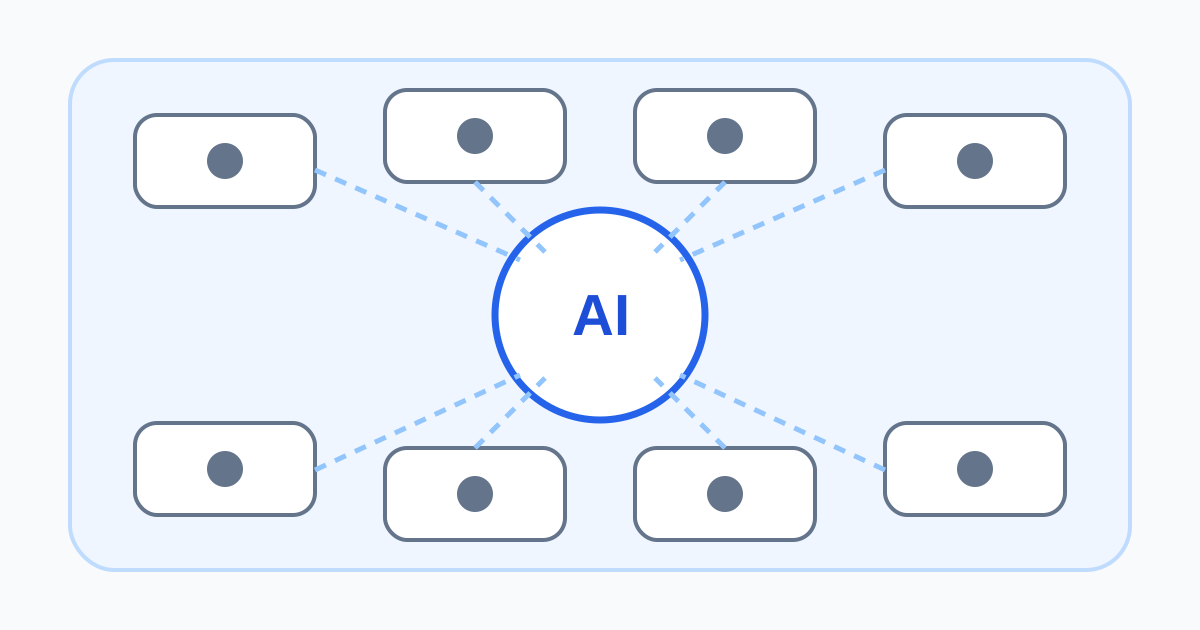
Andi is an AI-powered search engine that presents the web through a conversational interface. Instead of returning only a ranked list of blue links, it can generate a direct response, surface relevant pages, summarize material, and help a user continue exploring with follow-up questions. The product describes itself as ad-free and privacy-oriented, with basic search available without creating an account.
This positioning makes Andi closer to Perplexity or an answer engine than to a broad productivity assistant. Its main job is finding and organizing information from the web. It is not primarily a document workspace, coding environment, image studio, or business automation platform. That narrower scope can be an advantage when the user wants to move from a question to readable sources quickly.
Andi's official search page emphasizes generated answers, source discovery, an independent search experience, and deeper answer modes. Those claims describe the product's intended workflow, but they do not eliminate the need to test it on the topics that matter to you. Search quality depends on index coverage, freshness, language, ambiguity, and the quality of the pages available online.
Core Andi workflows
The simplest workflow is a natural-language web query. A user can ask a question in ordinary language, read Andi's synthesized response, and inspect the pages shown beside or below it. This is useful for learning an unfamiliar topic, discovering terminology, comparing an initial set of products, or collecting sources for a later research pass.
Follow-up questions help narrow a broad query without rewriting it from scratch. For example, after asking about a category of software, a user can request options for a smaller team, ask which choices publish security documentation, or focus on a particular platform. The conversation can preserve some context, but a follow-up may also inherit a mistaken assumption from the first answer. Restate critical constraints and verify the result.
Deeper answer or research features are more appropriate when a topic requires several sources. They can reduce the work of opening many tabs, but the generated narrative is still a secondary interpretation. Check the original publication date, author, methodology, and whether the linked paragraph supports the adjacent claim. A relevant page is not automatically evidence for every sentence in an AI summary.
Andi also offers browser-oriented access, which can make it a convenient alternative search entry point. Before making it a default search provider, compare how it handles local queries, current events, technical documentation, shopping, and non-English searches. No single search engine has equal coverage for every intent.
Pricing and account context
Basic Andi search is available anonymously and without an account. The terms of service also refer to account features and services that may require payment. Because plan names, sync capabilities, limits, and availability can change, this review does not freeze a price table that could become inaccurate.
Anonymous access is valuable for evaluation: it lets a user test answer quality and interface fit before providing an email address. An account may become useful for saved preferences or cross-device features. Paid cloud sync or backup should be evaluated separately from anonymous search because it necessarily changes where some content is stored and processed.
Privacy and data considerations
Andi's privacy policy makes unusually specific claims for anonymous search: it says searches are not logged, advertising profiles are not created, personal information is not sold, and general AI models are not trained on user data. It also distinguishes anonymous use from accounts and paid plans. Account email, optional profile information, payments handled by a processor, and content intentionally stored for sync are separate data flows.
The policy further states that settings and history for anonymous users can be kept in the browser, while cloud features involve storage. This distinction is practical. Clearing browser data, moving devices, signing into an account, or enabling sync can change the experience and retention model.
Privacy claims do not make generated answers private evidence or automatically suitable for regulated work. A query can itself reveal confidential plans, health concerns, legal strategy, customer details, or unpublished research. Remove unnecessary identifiers and use an organization-approved product when contractual security, audit, retention, or data-location controls are required.
Strengths and limitations
Andi's strengths are focus, low-friction anonymous access, and a clean relationship between an answer and the wider web. An ad-free model reduces the visual pressure of sponsored results, and the stated privacy approach is easier to evaluate than vague promises. It can be a productive discovery tool for people who dislike sorting through a conventional search page.
Its limitations are the limitations of answer engines generally. A fluent summary can hide uncertainty, merge incompatible sources, miss a newer page, or turn a source's narrow result into a broad conclusion. The best safeguard is a repeatable verification habit: open the strongest sources, prefer primary material, check dates, and search again with alternative wording.
Who should choose Andi?
Andi is a good fit for users who primarily need web discovery and want a conversational, private-by-default starting point. It is especially appealing for early research, topic exploration, and finding several readable pages without creating an account.
Choose Perplexity when citation-led research features and a larger research workflow are central, ChatGPT or Claude when the job extends into documents and production work, or a conventional search engine when exhaustive navigation, local results, and familiar operators matter most. The best approach may be to use more than one search product and compare sources rather than expecting one generated answer to be definitive.
Visit the official Andi website