What is Genspark?
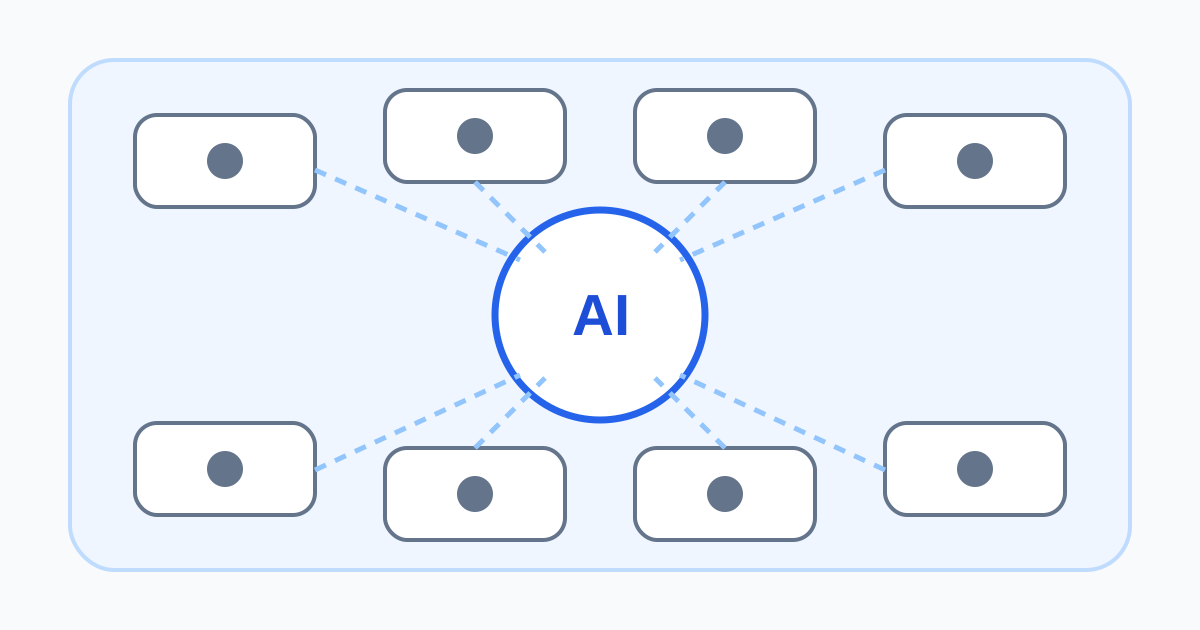
Genspark is an all-in-one AI workspace whose current scope is much broader than its original search-oriented identity. Super Agent accepts a goal, plans work, and coordinates specialized tools for research, analysis, documents, presentations, spreadsheets, code, design, media, email, and phone calls. Genspark's 2026 workspace architecture adds SecondBrain as persistent context, several Office, Build, and Content suites, and GenTeam for collaboration between people and agents.
This breadth is the main reason to consider Genspark—and the main reason to evaluate it carefully. A user can move from researching a market to generating a deck, analyzing an uploaded spreadsheet, building a small application, creating images or video, drafting email, and placing a real phone call without leaving one environment. That reduces tool switching, but it also concentrates files, conversations, permissions, and external actions under one account.
Super Agent, suites, and shared context
Super Agent is the orchestration layer. Official help material describes it as combining many models, tools, and integrations, with specialist agents for Slides, Sheets, Docs, design, and development. The Hub feature groups projects, instructions, conversation history, and uploaded files so later tasks can reuse context. Current documentation says a Hub can hold up to 100 supported files, generally limited to 10 MB each.
SecondBrain extends the idea from project context to persistent memory built from email, meetings, chats, documents, applications, and Genspark projects. Office tools create Slides, Sheets, Docs, and email; build tools cover code, design, databases, dashboards, and agents; content tools cover image, video, audio, and related production. The service also advertises multiple external model families, so model choice and routing may vary by task and over time.
Do not treat a broad tool list as proof that every workflow is best in class. Test a complete deliverable: source retrieval, citation support, numerical accuracy, editable file structure, brand consistency, revision effort, export quality, latency, and credit use. A polished slide deck can contain unsupported claims, a spreadsheet can use the wrong denominator, and generated code can be insecure even when the preview works.
Plans, credits, and the real cost
Genspark offers Free, Plus, and Pro individual tiers. At verification time, Plus was $24.99 month-to-month or $239.99 for a year, with credits issued monthly and a starting allowance of 10,000 credits. Pro was $249.99 monthly or $2,399.99 annually, starting at 125,000 monthly credits. Plus included 50 GB of AI Drive storage, while Pro listed 1 TB. The self-serve Team plan was $30 per seat per month, and Enterprise was positioned for 151 or more users with custom terms.
Some core chat, image, and dictation usage was advertised as zero-credit or unlimited on paid plans through December 31, 2026. “Unlimited” still has session-based fair-use controls, and expensive agents, video, audio, calls, or multi-step work can consume credits. Credits reset rather than carrying over in common plan changes. A Call for Me task alone has a fixed 500-credit real-time voice charge, plus text-model credits for task analysis and summaries.
Run a two-week workload test before annual purchase. Record credits and human time for each accepted research report, deck, spreadsheet, media asset, call, or deployed project. Include failed generations, retries, storage, seats, connector setup, review, and export cleanup. Temporary benefits and a large credit number do not by themselves establish predictable unit economics.
Privacy, third-party models, and retention
Genspark's privacy policy says it automatically collects prompts and resulting outputs. Depending on the feature, necessary text, reference images, voice recordings, or video inputs may be transmitted to third-party AI providers. Named primary providers include OpenAI, Anthropic, Google, xAI, and ElevenLabs, and additional providers may be added. The policy says Google Workspace API data is not used to develop, improve, or train generalized AI or ML models, but that statement is specific to Workspace API data.
The broader policy permits use of information to analyze, evaluate, and improve services. The terms say users retain intellectual-property rights in their uploaded content, while granting Genspark and its collaborators a worldwide, sublicensable license reasonably necessary to deliver the service; the stated purposes include operating, promoting, improving, and developing services. That is not the same as a clear universal promise that no submitted content will ever be used for model improvement.
Account-associated personal data is retained while the account is active or as needed to provide the service. The policy says account data is deleted from servers within 30 days after account closure, subject to other legal, auditing, fraud-prevention, and compliance needs. Confirm enterprise contractual overrides, data location, model routing, provider retention, backups, deletion evidence, workspace exports, and offboarding before placing confidential material in Hubs or SecondBrain.
Calls, meetings, email, and agent safety
Call for Me can make scheduled or immediate real phone calls, and the help page says the agent identifies itself at the beginning. Genspark stores a transcript and original audio recording for later playback; its privacy table says reservation-call recordings are stored for the user's future reference. Calling and recording laws vary, and a product disclosure does not replace the user's duty to obtain consent or follow sector rules. Never give an agent unnecessary health, insurance, financial, employment, or identity data for a call.
Email, connected applications, downloaded files, persistent memory, and generated code create similar concerns. Web pages and documents may contain prompt injection. A mistaken instruction can send a message, expose information, contact the wrong person, or generate a convincing but unsafe application. Use separate test accounts, least-privilege connectors, approved domains and recipients, restricted folders, spending limits, and human confirmation before any external or irreversible action.
For every repeatable agent, record the prompt and model version, approved sources, connector calls, files read and written, credits, output, reviewer, and final action. Give the workflow a named owner, stop mechanism, incident process, and deletion schedule. Persistent context should be curated and reviewed, not treated as an unlimited memory dump.
Verdict
Genspark is compelling for users who want research, office creation, code, media, communications, and multiple AI model families in one subscription. Its fast expansion can remove substantial friction from cross-format projects, and its transparent headline individual prices make a controlled trial easy to scope.
The same consolidation increases dependency and risk. Quality varies across tasks, credits and promotional benefits can change, and sensitive inputs may travel through multiple providers. The right buying process is a representative pilot with source-level accuracy checks, per-deliverable cost tracking, contract and privacy review, least-privilege connectors, and mandatory approval for calls, messages, publishing, purchases, code execution, or any other consequential action.