What is You.com today?
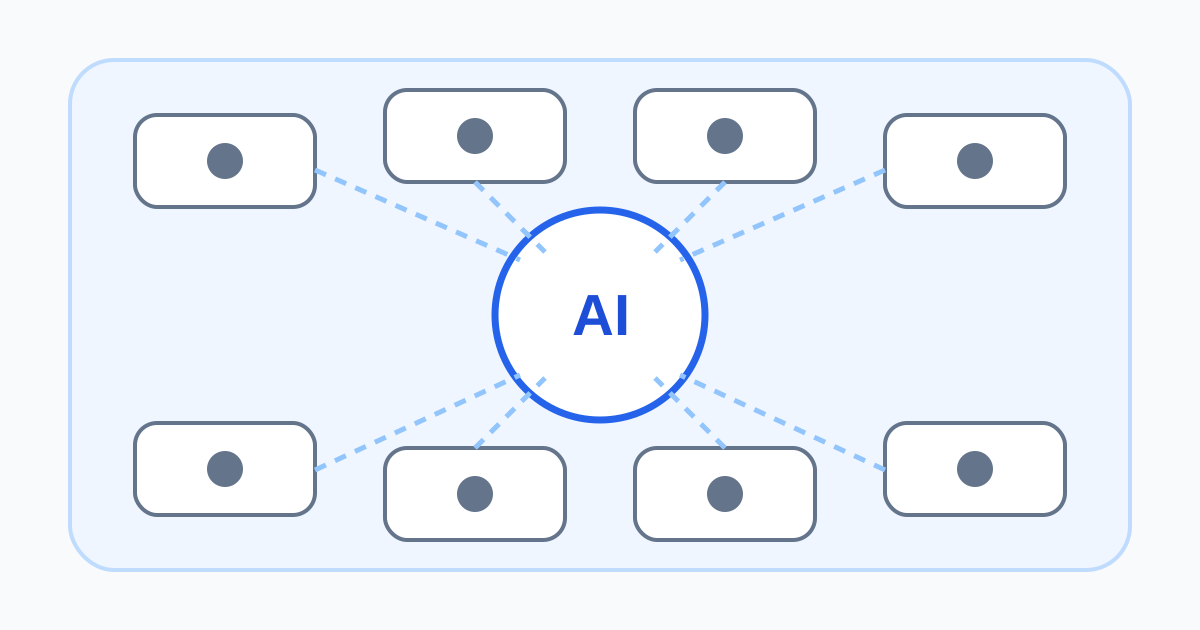
You.com is a real-time web-intelligence platform for developers and enterprises. Its current official documentation centers on four APIs: Web Search, Contents, Research, and Finance Research. This is an important positioning change. People who remember You.com as a consumer search engine or multi-model chat assistant should not assume the present product is the same experience. The primary value now is infrastructure that an engineering team embeds in an agent, assistant, knowledge product, research process, or retrieval-augmented generation pipeline.
The Web Search API returns web and news results as structured JSON. Results include URLs, titles, descriptions, query-aware snippets, metadata, and optional full-page HTML or Markdown through livecrawl. Search parameters cover result count, language, geography, recency, domains, and advanced operators. The Contents API accepts URLs and returns cleaned page content. Together, those services let a team own ranking, prompting, citation display, storage, and answer generation rather than adopting a finished interface.
The Research API sits one level higher. It plans and executes multiple searches, reads sources, cross-checks material, and returns a natural-language answer with inline citations. A caller can also define an output schema for structured JSON. Effort tiers trade cost and latency for more computation and source work. Finance Research provides a specialized path for financial questions. None of these outputs should be treated as an authoritative database or professional advice without verification.
Integration choices and practical workflow
You.com exposes REST endpoints, Python tooling, an OpenAPI specification, and integrations for frameworks including LangChain, LangGraph, LlamaIndex, Vercel AI SDK, n8n, and Zapier. A remote MCP server can give compatible coding tools and agents access to search, contents, and research. The free MCP search profile is useful for a quick technical evaluation, but a production design should use controlled credentials, explicit quotas, timeout and retry policies, caching, observability, and cost alerts.
Choose the lowest-level API that satisfies the product. Use Search when you need result control, your own reranking, or a custom answer pipeline. Add Contents when snippets are insufficient and you need page text. Use Research when a managed multi-step, source-backed synthesis is worth higher latency and price. Test each step separately: query interpretation, recall, source diversity, snippet faithfulness, livecrawl success, citation-to-claim support, answer completeness, and structured-output validation.
Web results are not automatically safe to execute or republish. Retrieved pages may contain prompt injection, malicious instructions, personal data, copyrighted text, stale claims, affiliate spam, or contradictory information. Separate untrusted content from system instructions, allowlist tools, limit content length, scan output, preserve source attribution, and require human review for high-impact decisions. Confirm that your intended storage, indexing, transformation, and display comply with publisher rights and applicable law.
Current API pricing
The official billing documentation checked August 9, 2026 says new accounts receive $100 in complimentary API credits without a card. Web Search is $5 per 1,000 calls and can return up to 100 results per call. Livecrawl is a separate $1 per 1,000 pages. Contents is $1 per 1,000 pages.
Research pricing depends on effort: lite is $12 per 1,000 calls, standard $50, deep $100, exhaustive $450, and frontier $1,200. Published latency targets range from under two seconds for lite to background jobs that may run much longer for frontier. A single search call can also trigger many livecrawl page charges, so request volume alone is not a complete cost model.
Model expected monthly cost with queries, results per query, pages crawled, retries, research-tier mix, failed requests, evaluation traffic, and caching. Confirm rate limits, concurrency, support, regional availability, volume discounts, service commitments, and overage behavior with You.com before committing. Pricing is usage-based even though this directory labels it paid because production access consumes credits.
Privacy, security, and procurement questions
You.com markets its APIs as enterprise-ready, with SOC 2 certification, DPA support, and zero data retention. Its platform security overview says data protection from retention and training applies in specified enterprise contexts. That distinction matters: do not convert a marketing badge into a universal promise for every free, platform, MCP, or contracted endpoint.
Document exactly what a request contains: user query, system context, private retrieval results, identifiers, IP address, logs, feedback, and generated answer. Ask which fields are retained for billing, security, debugging, abuse prevention, or support; whether content is used for model or product improvement; which subprocessors receive it; where it is processed; how deletion and backups work; and whether zero-retention terms appear in the signed agreement. Obtain the current SOC report, DPA, subprocessor list, incident terms, encryption details, access-control model, and tenant-isolation evidence appropriate to your risk.
The May 2026 API acceptable-use policy prohibits categories including unauthorized collection of sensitive information, platform abuse, malware, spam, bypassing safeguards, and certain illegal or harmful activities. Your own application still needs authentication, authorization, rate limits, abuse detection, output controls, user notices, and an incident process.
Verdict
You.com is worth a structured pilot when a product needs fresh web retrieval and cited research without building a crawler, index, extraction layer, and research orchestrator from scratch. Its strongest advantage is the choice between raw retrieval primitives and managed synthesis through one platform. Its largest evaluation risks are the same ones that determine whether any web-grounded AI system is trustworthy: relevance, freshness, source diversity, citation correctness, hostile content, latency, and cost at real traffic.
Run a representative offline benchmark, then a limited production trial. Compare against at least one alternative and a no-retrieval baseline. Track successful retrieval, unsupported claims, citation precision, source quality, p50/p95 latency, crawl failure, cost per completed task, cache hit rate, user correction, and serious safety errors. The right decision comes from that workload-specific evidence, not from a leaderboard or vendor claim alone.