What is HuggingChat?
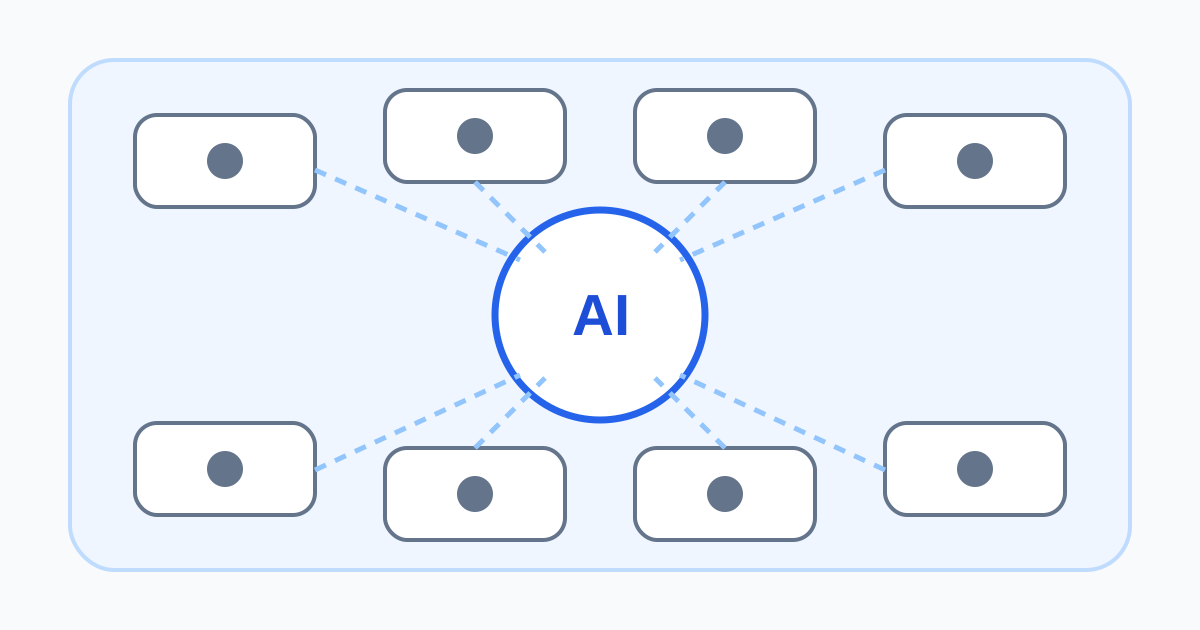
HuggingChat is Hugging Face's hosted conversational AI interface. It lets users chat with a changing selection of models without separately deploying each model or writing an API client. The software behind it, Chat UI, is open source and built as a general interface for OpenAI-compatible endpoints. Current documentation supports tools, multimodal inputs, intelligent model routing, and Model Context Protocol connections when configured.
This makes HuggingChat useful for exploration, not a single fixed assistant with a permanent model specification. The visible model, inference provider, context length, speed, tool support, and limits may change. A result from one week may not be reproducible after the service rotates models or changes routing. Record the exact model and date whenever an evaluation matters.
Model choice and practical quality
HuggingChat's appeal is access to the wider open-model ecosystem. Users can compare writing style, language support, reasoning behavior, coding, summarization, and image understanding across models. “Open,” however, has several meanings. A model may publish weights but use a license with restrictions; its training data may not be fully disclosed; and the hosted endpoint remains a cloud service even when the weights are downloadable.
Evaluate each model on the job it will perform. Use a fixed test set with factual questions, documents, adversarial instructions, multilingual prompts, refusal cases, structured output, long context, and domain-specific examples. Score citation support, hallucinations, consistency, latency, formatting, safety, and cost. Do not transfer a benchmark claim from the model card directly to a business conclusion.
Models can fabricate sources, produce insecure code, follow malicious instructions inside retrieved content, or reveal memorized material. An open license does not make output automatically copyright-safe. Check the model card, repository license, acceptable-use policy, provider terms, and output before commercial use.
Free access, PRO, and inference costs
The hosted chat has a free entry point, but Hugging Face does not present it as a simple unlimited consumer plan with one guaranteed allowance. Platform capacity, model providers, and fair-use controls can affect access. Hugging Face PRO costs $9 per month and provides broader Hub benefits, higher ZeroGPU priority, and 20 times the included Inference Providers credits of a free account.
At verification time, Inference Providers documentation listed $0.10 of monthly routed-inference credit for a free user, $2 for a PRO user, and $2 per seat for Team or Enterprise organizations. Extra usage can be pay-as-you-go after credits. Hugging Face says routed requests use provider prices without markup, but cost still varies substantially by model and task. These developer-platform credits should not be confused with a contractual HuggingChat message allowance.
For sustained use, measure the exact model, input and output size, provider, failed requests, queue time, tool calls, and accepted output. Compare PRO plus usage with a direct provider account or a controlled self-hosted model. The cheapest token is not the cheapest completed task if quality creates more review and retries.
Conversation privacy and provider boundaries
HuggingChat's app-specific privacy notice says conversations are private to the user, are not shared with model authors, and are not used for research or model training. Conversation data is stored to provide history, and the user can delete past conversations. Hugging Face staff have also stated in the app's official discussion area that deletion removes the conversation from its database rather than soft-deleting it.
This strong app-level statement needs context. Hugging Face's general privacy policy separately covers the broader platform and permits information use for delivering, operating, improving, analyzing, and researching services. It retains information as long as necessary for service delivery, legal requirements, security, and legitimate interests. Users can request erasure, but the policy does not give one universal numeric retention period for every data class.
Inference routing introduces another boundary. Hugging Face says its Inference Providers router does not store request or response bodies for training, and debugging logs are kept up to 30 days without user data or tokens. It also tells users to review each external provider's security policies. If a tool, MCP server, custom endpoint, or self-hosted operator is involved, that party may see data under different rules. App privacy, router privacy, model-provider privacy, and tool privacy are distinct layers.
Self-hosting Chat UI
Chat UI can connect to Hugging Face Inference Providers, Ollama, llama.cpp, OpenRouter, or another OpenAI-compatible service. A team can deploy it locally or in its own cloud, choose authentication, and control the model endpoint. That is valuable for architecture, customization, and avoiding dependence on the public HuggingChat model roster.
Self-hosting is not privacy by magic. Chat UI uses MongoDB in normal deployments and can fall back to an embedded persistent database in development. The operator must secure database access, encryption, backups, environment secrets, user authentication, logs, model endpoints, MCP tools, network egress, patches, deletion, and incident handling. Sending requests from a private UI to a public model API still sends the content outside your environment.
Start with an isolated deployment and non-sensitive test data. Use least-privilege tokens, pin versions, restrict outbound destinations and MCP tools, log administrative changes, and define retention before users arrive. If anonymous or shared use is allowed, address abuse, moderation, rate limiting, and tenant separation.
Verdict
HuggingChat is an excellent low-friction window into conversational models and a useful demonstration of what an open-source chat layer can do. It is especially attractive for learning, comparison, prototypes, and teams considering their own model-neutral interface.
It should not be sold internally as “the private open-source ChatGPT” without qualification. The hosted app stores conversation history, inference may cross provider boundaries, available models rotate, and self-hosting transfers substantial security and operations work to the deployer. Use a documented test set, record model and provider, keep sensitive data out of public experiments, and verify every layer of the actual deployment before adopting it for confidential or consequential work.