
What is Kagi Assistant?
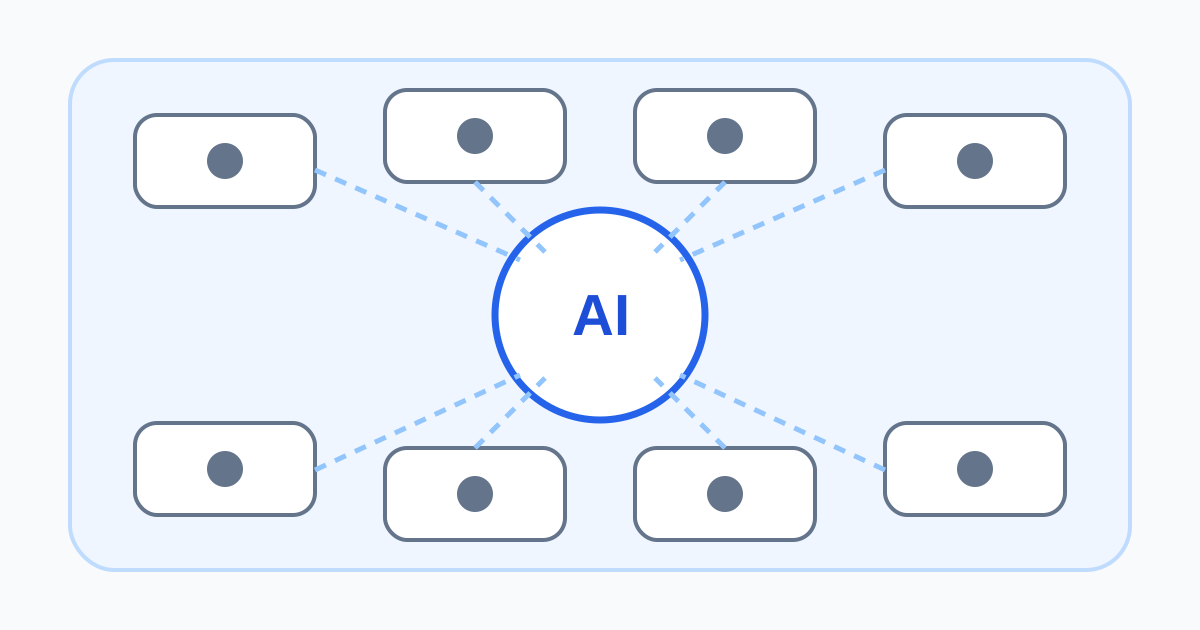
Kagi Assistant is a paid multi-model chat interface built around Kagi Search. It gives subscribers access to models from providers such as Anthropic, OpenAI, Google, Mistral, Alibaba, DeepSeek, xAI, and others, while Kagi acts as the intermediary. A user can enable or disable web access, apply a Kagi Search Lens, include personalized search results, switch models during a conversation, and create custom assistants with dedicated instructions.
That combination is the main reason to consider it. Direct model subscriptions may have deeper provider-specific features, while Duck.ai emphasizes anonymous, low-friction chat. Kagi Assistant is strongest for someone already using paid Kagi Search who wants the same search index, domain preferences, lenses, and privacy model inside a flexible AI workspace.
Current features include saved threads and folders, Markdown or JSON export, share links, syntax highlighting, keyboard shortcuts, voice input, and broad file support. It can analyze PDF, DOCX, PPTX, spreadsheets, JSON, images, audio, and text, with a combined upload limit of 30 MB. Pasted online documents can be fetched up to 50 MB when web access is enabled. Treat every fetched page and uploaded file as untrusted input: prompt injection, hidden instructions, private data, and misleading content can still affect an answer.
Models, search grounding, and custom assistants
The live model catalog is large and changes frequently. Some standard models are available across plans; flagship models and reasoning variants are limited to Ultimate. The best model depends on language, task, cost, latency, context, and provider policy. Kagi publishes recommendations and benchmarking, but a vendor-run benchmark is not a substitute for testing your own prompts and acceptance criteria.
Web access uses Kagi Search rather than letting every provider independently browse. Lenses can narrow results to selected sites or themes, and personalized results apply a user's raised, lowered, pinned, or blocked domains. That control can improve relevance, but it can also reinforce an incomplete source set. For research, inspect cited pages, publication dates, authorship, and whether each citation supports the nearby claim. Compare with sources outside the lens when a decision needs breadth.
Custom assistants combine a chosen model, optional search and lens configuration, and up to 20,000 characters of instructions. They are useful for repeatable editing, research, study, or coding workflows. They are not isolated software agents with independent authorization. Never place reusable credentials or sensitive records in custom instructions, and do not assume an instruction can prevent a model from following hostile content in an uploaded file.
Limits and actual economics
Kagi's plan structure checked August 9, 2026 lists a Trial with 100 total searches and 100 standard-model AI interactions. Starter is $5 per month plus tax and includes 300 searches and 300 standard-model AI interactions. Professional is $10 monthly with unlimited search, Universal Summarizer, and standard-model Assistant access. Ultimate is $25 monthly and adds premium models and Research mode. Annual Ultimate receives a 10% discount; family and team configurations have separate upgrade rules.
“Access” does not mean unmetered model tokens. Kagi uses value-based fair use: a $25 monthly plan provides up to $25 of calculated AI usage, including a 20% margin for search queries, infrastructure, and development. In Kagi's example, $20 represents raw token cost and $5 the margin. Annual subscribers receive the full annual allowance at the start; the published Ultimate example is $270. When usage is exhausted, new AI interactions are disabled until early renewal or the next cycle. Top-up credits were described as forthcoming, so do not budget around them until live.
There is no fixed conversation-count limit, but message input is capped at 100,000 characters. At roughly 32,000 tokens of chat history, the service starts summarizing and truncating older context. That makes long threads convenient yet less reproducible. Start a fresh thread for a new task and export important source material, decisions, and final output.
Privacy and retention
Kagi says Assistant connections are proxied through its servers, account information is not shared with model providers, and neither Kagi nor the providers use conversation data for model training. Threads are deleted after 24 hours of inactivity by default; users can select permanent retention. Public-page summaries may be cached for no more than a day, and Kagi's broader privacy policy describes temporary request debugging that can create limited retention exceptions.
Kagi is an account-based paid service, so privacy is not identical to anonymity. Its policy documents pseudonymous email, cryptocurrency payment, Tor access, and Privacy Pass as ways to reduce linkage. Payment processors still handle billing, and saved or shared threads create deliberate persistence. Review the specific LLM provider's policy through Kagi's comparison, because provider endpoints and guarantees differ.
For confidential organizational use, ask about encryption, support access, subprocessors, processing locations, deletion backups, incident response, export, account recovery, legal requests, and whether contractual enterprise terms exist. A consumer privacy promise is useful but not automatically a complete procurement package.
Verdict
Kagi Assistant is a differentiated choice for paid-search enthusiasts who want multiple models, controllable web grounding, and privacy-conscious routing in one subscription. Ultimate offers the full experience, but its token-value allowance means expensive reasoning models can consume the monthly budget quickly. The best evaluation is a one-month pilot using representative research, writing, coding, and file tasks.
Track source support, factual corrections, time saved, token allowance consumed, search relevance, latency, and the frequency with which old context is lost. Export important work, keep sensitive content out until controls are approved, and verify every consequential result. Kagi provides a thoughtful interface and business model; it does not remove the limitations of the underlying models or the open web.