
What is Obviously AI?
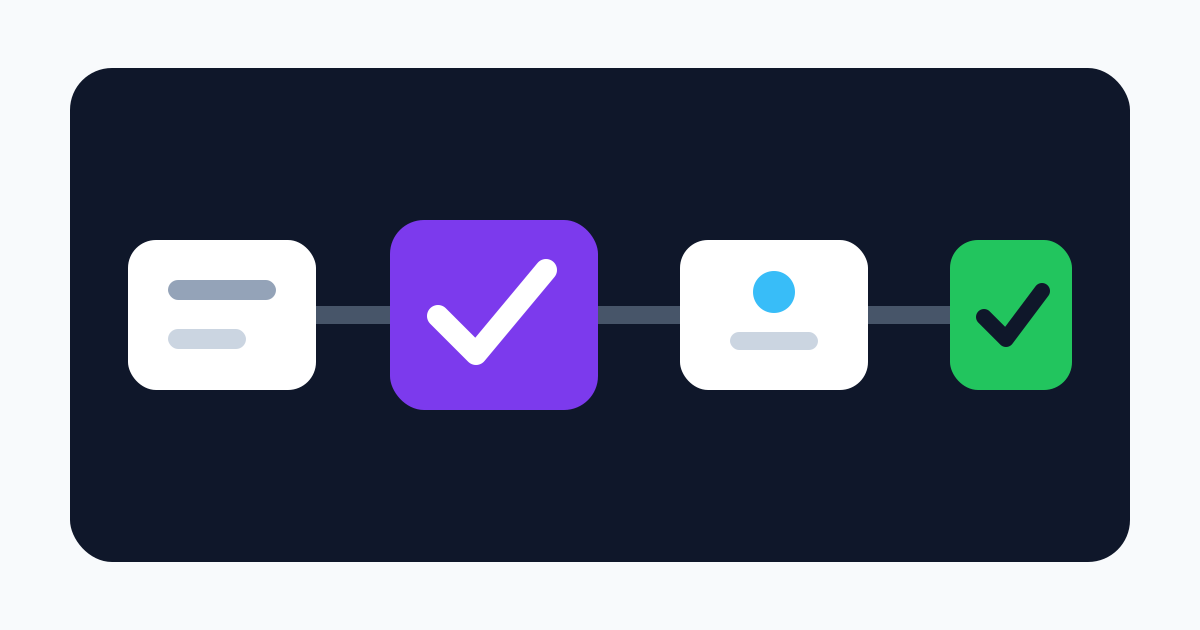
Obviously AI is a no-code platform for predictive machine learning and AI automation. A user supplies structured historical data, chooses an outcome, and asks the platform to build a classification, regression, time-series, or clustering model. The result can be explored in a dashboard, shared through a web app, called through a REST API, monitored over time, or connected to an automation. The current pricing page also presents AI agents, recurring reports, custom LLMs, and RPA-style workflows alongside the classical predictive stack.
Its promise is speed and accessibility, not the removal of data science. The interface can automate preprocessing, candidate-algorithm selection, hyperparameter search, validation, and deployment. It cannot decide whether historical data represents the future, whether the target is lawful, whether a proxy creates discrimination, whether an intervention caused an outcome, or whether the business will use a prediction responsibly.
From dataset to deployed prediction
Official algorithm documentation says Obviously AI examines dataset properties, shortlists candidate algorithms, tries many hyperparameter combinations, and selects a high-performing result. Supported approaches include familiar linear, probabilistic, tree, ensemble, and neural methods depending on the task. Product pages focus on churn, lead conversion, loan repayment, fraud, sales, pricing, yield, costs, demand, and other structured outcomes.
Before uploading, define one prediction timestamp and remove information that would not have existed then. Leakage can make a test score look excellent while making production predictions useless. Split training, validation, and final test data by time or entity where appropriate; keep the final set untouched until model selection ends. Compare the model with a simple baseline and calculate business metrics such as precision at the action capacity, false-positive cost, calibration, and performance by important groups—not only a headline accuracy number.
Deployment options create additional risk. A prediction web app can be shared by link, an API can score records in real time, and a Zapier-style rule can trigger an action when probability crosses a threshold. Begin with a recommendation queue. Log input versions, model versions, confidence, reviewer decisions, outcomes, overrides, and failures. Never let a score automatically reject a loan, applicant, patient, claim, or investigation without appropriate legal basis, appeal, human review, and domain validation.
Free and paid plan limits
The Free plan is described for individuals, hobbyists, and nonprofits. It lists one seat, 1,200 predictions, unlimited models, CSV-only input, classification, regression, time-series, clustering, AI agents, custom LLMs, REST APIs, RPA automations, email support, files up to 10 MB, and up to 10,000 rows per processing job. The same page separately mentions one million rows of training data, so a buyer should confirm how cumulative training volume and per-job processing limits interact.
The paid Software + Data Scientist packages do not show numeric prices. Startup lists one use case, up to 100 MB files, and up to one million rows. SMB lists three use cases, 1 GB files, and 100 million rows. Enterprise lists five use cases, 10 GB files, and 250 million rows. The page presents agents, predictive models, reports, dashboards, APIs, fine-tuning, monitoring, a dedicated strategist and data scientist, and video or chat support. Governance features such as SAML/SSO, audit trails, data residency, custom sources, and private cloud appear as advanced considerations whose exact plan availability should be confirmed in writing.
A “prediction” is counted per record returned: scoring 100 uploaded rows consumes 100 predictions. Cost modeling therefore needs batch size, API traffic, retraining cadence, number of use cases, file and row limits, support hours, and required deployment controls.
Security, privacy, and unanswered diligence questions
Obviously AI's security page says customer data is encrypted with TLS in transit and AES-256 at rest in Google Cloud infrastructure. It lists an annually audited SOC 2 Type II report covering security, confidentiality, and availability, GDPR support and a DPA, CCPA controls, and HIPAA support with a qualifying BAA. These are vendor claims; request the current reports, scope, exceptions, architecture, subprocessors, incident commitments, and actual region configuration.
The privacy policy, updated February 2025, focuses mainly on account and website personal information. It says personal information is generally retained no longer than 90 days after account termination, except for legal or operational exceptions, and backups may be isolated until deletion is possible. That is not a complete data-processing specification for uploaded training data, trained models, features, predictions, agent prompts, API logs, reports, or human data-scientist access.
Before sensitive use, obtain contractual answers about whether customer data or derived artifacts are used to train shared models, who can access datasets, retention for every artifact and backup, deletion verification, subprocessor destinations, regional processing, support access, model portability, and what is returned or destroyed at termination. Do not infer these details from a generic security badge.
Verdict
Obviously AI can shorten the path from a structured business question to a working predictive prototype, particularly for teams without ML engineering capacity. Its software-plus-expert model may also help with cleaning and deployment. The evaluation succeeds only if it measures data quality, leakage, fairness, calibration, drift, operational value, and governance alongside speed. Use it to make model development more accessible, not to make statistical accountability disappear.