
What is Venice AI?
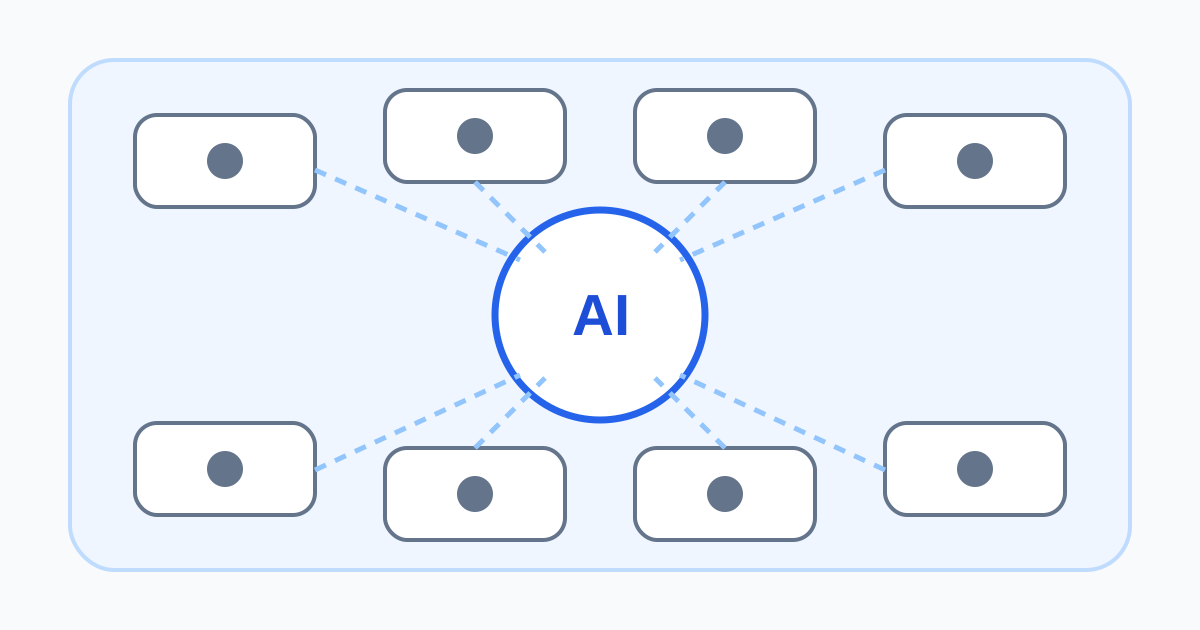
Venice AI is a multimodal assistant and model-access platform built around a privacy-focused product story. It offers text chat, web search on eligible models, image generation and editing, video and music features through credits, customizable characters, document uploads, and an OpenAI-compatible API. Rather than presenting every model as equally private, Venice publishes several privacy categories with different technical and contractual properties.
That distinction is the most important part of evaluating Venice. The service can provide access to open models, privacy-enhanced infrastructure, and selected frontier models from other providers. The privacy mode attached to a specific model determines what Venice claims about retention, provider visibility, trusted execution, or end-to-end encryption. Users should not reduce this to a single statement such as “Venice is private” without checking the selected model and current mode.
The official features page describes text, image, video, code, character, file, and API workflows. It also shows that limits and advanced controls depend on the plan and model. Because the model catalog changes quickly, a durable review should focus on the workflow and privacy classification rather than freeze a list of model names.
Core Venice workflows
Text chat covers familiar tasks such as brainstorming, rewriting, explanation, research, and code assistance. Some models can use web search, system prompts, uploaded documents, or adjustable generation settings. The right model depends on whether the priority is reasoning quality, privacy level, context length, speed, or price. A model with the strongest benchmark reputation may not be offered in the strongest privacy mode.
Image features include generation and controls such as negative prompts, dimensions, seeds, higher-resolution output, variations, and editing utilities on eligible plans. This makes Venice useful as a creative workspace, but output still needs human review. Generated images can reproduce unwanted artifacts, inaccurate product details, misleading people, or material that creates licensing and brand risks.
Video, music, and premium media workflows use credits. They are better treated as metered production tools than as unlimited plan features. Before starting a large project, estimate how many generations and revisions are likely, check commercial-use terms, and confirm whether an output watermark or model-specific restriction applies.
Developers can use the OpenAI-compatible API to access supported text, embedding, image, audio, and video models. Compatibility can reduce migration work, but model identifiers, supported parameters, privacy categories, rate limits, and prices still differ. Test error handling, streaming, tool use, context limits, and output consistency before replacing an existing provider.
Pricing and credits
Venice offers a free tier with limited text and image access. Paid consumer plans increase model availability and usage, add monthly credits for premium media or models, and can provide privacy-enhanced features and encrypted backup. The product also offers higher tiers with substantially larger credit allocations.
The API follows separate model-level pricing. Venice's official pricing documentation lists token, image, audio, and media costs as well as the privacy category associated with models. These values can change often, so compare current prices immediately before deploying a high-volume workload.
Credits make cost less predictable than a simple unlimited subscription. Track the cost of unsuccessful generations and revisions, not just final outputs. For an API project, estimate input, output, caching, media duration, and retry behavior with realistic traffic.
Privacy architecture and trade-offs
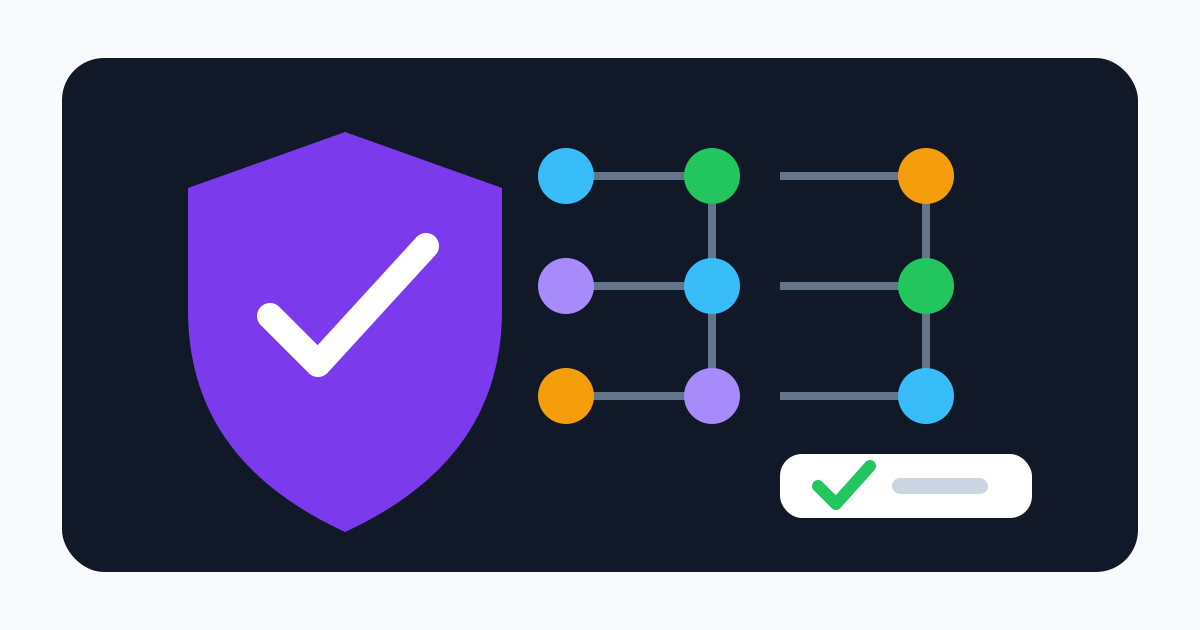
Venice's privacy architecture describes four modes. Anonymous mode obscures the user's identity from a frontier model provider, but Venice tells users to assume that provider may store prompt content. Private mode claims zero data retention enforced through provider agreements. TEE mode adds hardware-isolated processing, while E2EE mode is designed to keep content encrypted through a verifiable path. TEE and E2EE access are plan- and model-dependent.
The documentation also says standard conversation history remains on the device and that requests pass through a Venice proxy without being stored there. Optional backup changes the storage workflow, even if the backup is encrypted. Clearing browser data, changing devices, sharing a conversation, enabling backup, or using an external provider model can therefore change the practical privacy outcome.
These claims are useful because they expose trade-offs, but they are not a substitute for a security assessment. Organizations should verify contracts, subprocessors, data locations, authentication, access logs, retention, incident response, and whether the exact model used for a workflow meets policy. Do not infer enterprise compliance from a consumer-facing privacy description.
Strengths and limitations
Venice's strongest quality is choice made visible: users can compare model capabilities and privacy modes rather than accept one hidden routing policy. The breadth of text, media, and API workflows can also reduce the need for several accounts.
The cost of that flexibility is complexity. Plan limits, credits, models, and privacy labels can change, and users must understand what each mode protects. The service also shares the limitations of generative AI generally: confident errors, unsafe code, weak citations, visual artifacts, and possible rights issues.
Who should choose Venice AI?
Venice is worth evaluating for privacy-conscious individuals, multimodal creators, and developers who want explicit model and infrastructure choices. Start with non-sensitive material, compare at least two models, and confirm the privacy badge for every important workflow.
Choose ChatGPT or Claude when a mature document and collaboration workspace matters more than routing choice, Perplexity when source-led web research is the primary need, or a direct API provider when contractual simplicity and one model family are priorities. Venice is most compelling when its privacy classifications and multi-model access solve a real requirement rather than simply adding more options.
Visit the official Venice AI website