What is Midjourney?
Midjourney is an AI image-generation service built around visual exploration. A user describes a scene, supplies optional image or style references, then develops promising results through variations, reruns, reframing, and edits. Its value is not only the first generation. The product is strongest when treated as an iterative visual workspace in which a rough direction becomes a family of related compositions.
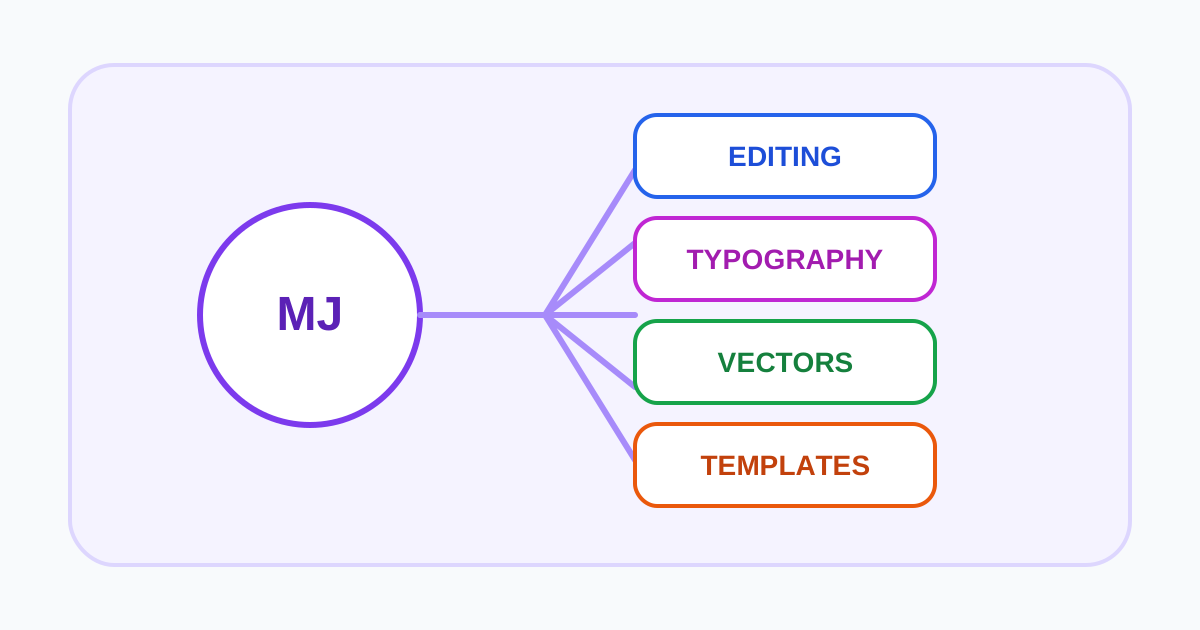
That makes Midjourney a common candidate for concept art, mood boards, editorial illustration, campaign exploration, character studies, and visual ideation. It is less suitable when the deliverable requires exact editable typography, production-ready vectors, verified product geometry, or a guaranteed legal clearance. Those requirements still need conventional design tools and accountable human review.
Generation and editing workflow
Midjourney's web experience provides creation, organization, and editing surfaces. Prompts can be combined with parameters and references that influence subject, composition, or style. Variations help search around a result rather than restart from zero, while personalization can adapt generations to preferences inferred or selected by the user.
The official Midjourney Editor supports operations such as modifying selected areas, changing the canvas, and working with uploaded images. The exact controls evolve, so evaluate the current editor with the kind of corrections your work actually requires. Generative editing is useful for extending a background or replacing an object, but it does not provide the deterministic layer structure of Photoshop, Illustrator, or a layout application.
A practical test should use a series, not a single hero image. Ask the tool to maintain a character, product category, palette, or art direction across several compositions. Record how many generations and manual edits are needed before the set is coherent. A visually impressive one-off can hide weak consistency or expensive iteration.
Plans, GPU time, and real cost
Midjourney's official plans page is the source of truth for current subscription tiers. Plans can differ in fast GPU allocation, relaxed generation access, concurrency, and privacy features. Avoid estimating cost from the monthly fee alone.
Model a representative workload: initial grids, prompt experiments, variations, edits, upscales, discarded outputs, and the number of people creating simultaneously. A team that produces many variants may value relaxed generation, while deadline-driven work depends more on fast capacity and queue behavior. Confirm renewal, cancellation, unused-time, and concurrency rules before standardizing the tool.
Public creations, Stealth Mode, and rights
Privacy is a central buying criterion. Midjourney describes its service as an open community: creations may be visible through its website or other surfaces and can be remixable under platform features. The official guide to keeping creations private explains that Stealth Mode is limited to eligible plans. Enabling it does not retroactively hide images that were already public, and generating in a shared Discord space can still expose the work to people in that space.
Read the current terms of service before commercial use. The terms distinguish rights granted to the user, the license granted back to Midjourney, and obligations relating to uploaded content. They also currently include a plan requirement for companies above a stated annual-revenue threshold. This is especially important for agencies working on behalf of larger clients: the applicable company and subscription should be confirmed, not assumed.
Contractual permission is not the same as copyright certainty. Users must clear uploaded references, recognizable people, trademarks, protected characters, and client material. In some jurisdictions, the copyright status of predominantly AI-generated output may also be limited. Keep an asset log that records inputs, human edits, approvals, and where each image is used.
Strengths, limitations, and alternatives
Midjourney is compelling when the goal is to search a broad visual space quickly. Its references, parameters, variations, and established creative community offer more depth than a one-button generator. The learning curve is the corresponding trade-off: good results depend on art direction, selection, and iteration rather than prompt length alone.
Choose Ideogram when accurate text inside generated graphics is a central requirement. Consider Recraft for vector-oriented and brand-style work, Adobe Firefly for integration with Adobe editing workflows, or Krea for real-time exploration and access to a broader creative suite. The right alternative depends on the final file and review process, not on a universal image-quality ranking.
A fair production benchmark
Use a fixed brief that requires more than visual novelty: a consistent subject, a specific product detail, negative constraints, three aspect ratios, and a revision requested by a stakeholder. Record prompt and reference inputs, model and parameters, generations, variations, upscales, editor work, rejected outputs, queue time, plan mode, and total time to an approved asset. Compare that complete cost with the team's current process.
Inspect final files at delivery size for anatomy, logos, text, background objects, cultural cues, and details that could misrepresent a product. Test whether another operator can reproduce the direction and make a controlled change. Before confidential work, confirm visibility, Stealth availability, member permissions, reference handling, deletion, and current terms. Save prompts, source rights, exports, and human edits in the campaign record.
Midjourney is a strong exploration tool when its aesthetic range reduces concept time. It is a weaker choice when editable structure, deterministic revisions, private-by-default work, or an auditable API pipeline is the primary requirement.
Visit the official Midjourney website