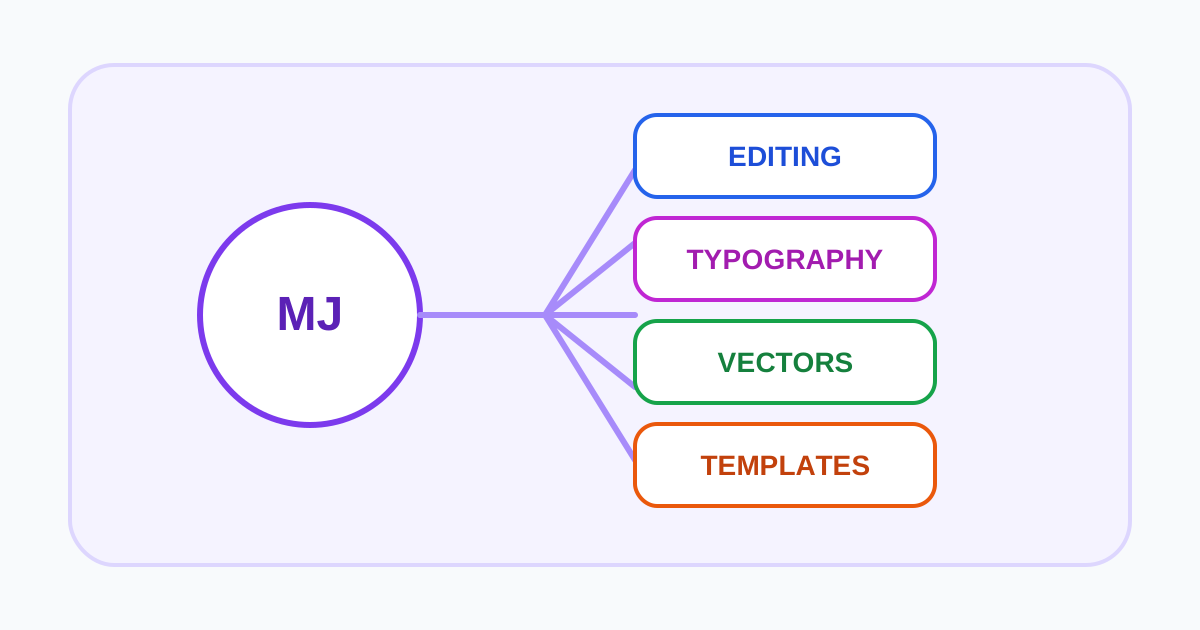
The best Midjourney alternative depends on why Midjourney does not fit. If text inside images is the problem, start with Ideogram. If the final asset must be a vector, test Recraft. Adobe Firefly is the most natural candidate for an Adobe production workflow, while Canva Magic Studio is stronger for templates, brand kits, and team communication. Krea emphasizes real-time exploration, and Leonardo AI offers a broad multi-model creator workspace.
Other alternatives solve narrower problems. Playground AI combines generation with lightweight layout. Clipdrop focuses on image-processing utilities. Microsoft Designer is accessible for personal creation, but Microsoft's current consumer FAQ says it is licensed for personal, non-commercial use, so it is not a default business replacement.
Midjourney itself remains a strong choice for visual exploration. Switching makes sense only when another product fixes a recurring workflow, privacy, pricing, rights, or production constraint. This guide is based on official sources reviewed in August 2026 and does not claim a controlled image-quality benchmark. Read our Midjourney review, best AI image generators guide, and AI image and design directory for broader context.
Quick recommendations by reason to switch
| Why Midjourney does not fit | Start with | What changes | Main caution | | --- | --- | --- | --- | | Text in the image is unreliable | Ideogram | Strong product focus on rendered words and graphic composition | Generated text is still pixels and requires proofreading and often rebuilding | | You need vectors, icons, or brand styles | Recraft | Vector generation, vectorization, styles, editing, and API | Free-tier assets are owned by Recraft and are not commercial-use assets | | The asset must enter Adobe production | Adobe Firefly | Generation and edits connect to the Adobe ecosystem | Partner models and Adobe Firefly models should not be treated as identical | | You want a broad model and Canvas workspace | Leonardo AI | Multiple models, guidance, realtime Canvas, personal models, video, and API | Tokens, relaxed mode, visibility, and ownership depend on plan and model | | You want real-time art direction | Krea | Live feedback plus image, video, 3D, enhancement, and node workflows | Compute and provenance are less predictable across modes and providers | | Templates and team communication matter | Canva Magic Studio | AI sits inside templates, brand assets, collaboration, and format adaptation | AI, template, stock, and partner-app rights need separate review | | You want a lighter design editor | Playground AI | Generation, templates, resizing, background tools, and Smart Layers | Current free-plan output is presented as non-commercial | | You only need cleanup or background work | Clipdrop | Focused tools and APIs instead of a full art generator | It cannot replace Midjourney's concept exploration or a layered editor | | You are making personal designs in Microsoft services | Microsoft Designer | Simple images, cards, posts, stickers, collages, and edits | Consumer license is currently personal and non-commercial |
First identify the actual Midjourney constraint
“I need an alternative” is not a useful procurement requirement. Write down the repeated failure:
- creations need to remain private under a lower-cost or business-approved plan;
- words, numbers, or logos inside the image require too much repair;
- the final output must be a usable vector or editable design;
- the team already finishes work in Adobe or Canva;
- subscription and GPU-time economics do not match the volume;
- the user wants free evaluation before committing;
- several model providers need to be compared in one account;
- live visual feedback would speed art direction;
- the real job is background removal, cleanup, uncrop, or upscaling;
- the organization needs a particular API or data agreement.
Then test only products that address that constraint. Replacing one broad generator with another without a defined reason often recreates the same correction, rights, and cost problems.
What Midjourney currently does well
Midjourney combines prompt generation with image and style references, parameters, variations, personalization, organization, and editing. For mood boards, editorial imagery, character concepts, campaign directions, and stylistic exploration, the iterative environment is the product's core strength.
Its main decision points are equally clear. Midjourney is a paid service. Creations are generally part of an open community unless an eligible plan and Stealth Mode are used correctly. Stealth does not retroactively hide earlier public work, and generation in shared spaces can remain visible there. Current terms also include a plan condition for companies above a stated annual-revenue threshold.
An alternative should improve one of those conditions without making the final workflow worse. A cheaper generator is not a better alternative if it produces public work, lacks required export formats, or adds more correction time.
Ideogram: the alternative when text is central
Ideogram is the clearest first test when Midjourney concepts fail because words are part of the visual. Posters, signs, title cards, social graphics, packaging directions, and logo ideas all depend on the relationship between text and imagery.
Its advantage is product focus, not guaranteed typography. Test exact spelling, punctuation, long words, numbers, mixed case, non-English scripts, hierarchy, and small sizes. Synthesized lettering is not a licensed editable font layer. Important copy should usually be rebuilt in a design application.
Plans differ in credits, priority, and private generation. Ideogram also has separate licenses for downloadable model weights. A hosted-app user and an organization deploying model weights are making different legal decisions.
Switch from Midjourney to Ideogram when text repair is the recurring bottleneck. Keep Midjourney when broad visual exploration matters more than lettering.
Recraft: the alternative for vectors and design systems
Recraft is the most direct alternative when the final deliverable is an icon, vector illustration, brand-style asset, or editable design component. It combines raster and vector generation, vectorization, styles, editing, background tools, and API access.
Evaluate files in the actual downstream application. An SVG can contain excessive paths, awkward masks, flattened text, broken gradients, or structures that are difficult to revise. A useful test is a family of related icons or illustrations, not one isolated asset.
Rights determine which plan is viable. Recraft's current terms say free-tier creations are public, owned by Recraft, and limited to personal, non-commercial use. Paid users own assets created during their subscriptions and receive private generation and commercial rights. Generated assets also carry a restriction against AI training under the current terms.
Switch from Midjourney to Recraft when editable design assets and style systems are the real requirement. Do not use the free tier to create final commercial deliverables.
Adobe Firefly: the alternative for Adobe production
Adobe Firefly is a logical alternative for teams that already move every generated concept into Photoshop, Illustrator, Premiere Pro, Express, or another Adobe workflow. Image, video, audio, and generative editing can sit closer to the finishing tools.
The Firefly application can provide Adobe models and selected partner models. Record the exact model behind approved work. Adobe's descriptions of its Firefly model training and commercial-use position are relevant to Adobe models and should not be generalized without checking the partner model and applicable terms.
Firefly plans use generative credits, and different media, operations, resolutions, durations, or models can consume them differently. Compare total production cost, including the Adobe applications and human editing needed after generation.
Switch from Midjourney to Firefly when integration and governance reduce repeated handoffs. Continue to clear source assets, trademarks, people, protected designs, and factual product details.
Leonardo AI: the alternative for a broad model workspace
Leonardo AI combines first- and third-party models with generation, guidance, editing, a real-time Canvas, collections, personal model training, video, and API access. It can replace several separate creative subscriptions for users who are willing to manage a token system.
The main benefit is optionality. The main cost is provenance and plan complexity. Each approved asset should record model, settings, references, and post-processing. Token use varies by action. Relaxed generation on selected paid plans applies to eligible first-party models, while third-party models and other operations can continue consuming tokens.
Free creations are public under the current product description and have different platform rights from paid private generations. Commercial permission does not make a public workflow confidential.
Switch from Midjourney to Leonardo when model breadth, Canvas, custom models, or API access solve a defined need. Model the exact workload rather than comparing one monthly price.
Krea: the alternative for real-time visual feedback
Krea is a strong alternative when waiting for discrete image grids interrupts art direction. Its real-time experience lets users adjust text or visual input and see a direction evolve more interactively. The suite also covers higher-quality generation, editing, video, 3D, enhancement, custom styles, nodes, and API use.
Fast feedback should be followed through to the final export. Measure whether the selected subject, composition, palette, and details survive the transition from real-time preview to render, edit, upscale, and downstream software.
Plans use compute units that vary by model and operation. API access and downloadable Krea 2 model licensing are separate routes. Krea 2 licensing includes commercial conditions such as a company-wide revenue threshold; it is not the same as an app subscription.
Switch from Midjourney to Krea when immediacy changes how the creator works. Confirm which model and data terms apply to sensitive projects.
Canva Magic Studio: the alternative for templates and collaboration
Canva Magic Studio is not one model. It is a collection of AI capabilities inside Canva's template, asset, editing, collaboration, and publishing platform. The workflow can move from generation to a presentation, social campaign, document, flyer, or video without a separate layout handoff.
This is a better replacement than Midjourney when the repeated challenge is turning a concept into many branded formats. Test fixed copy, brand colors, a real product, several aspect ratios, team approvals, and final exports.
Rights exist at several layers: user uploads, AI output, Canva templates or stock content, and third-party apps. Limits also vary by feature, plan, account, and region. A broad Canva subscription does not make every asset or AI provider identical.
Switch from Midjourney to Magic Studio when communication production and team consistency matter more than deep generation parameters.
Playground AI: the alternative for lightweight design
Playground AI now emphasizes design templates, generation through modern image models, resizing, background tools, upscaling, and Smart Layers. Many older comparisons describe a materially different product, so evaluate the current interface.
It is useful when the user wants to generate and arrange a poster, social graphic, invitation, or product visual in one browser workflow. Smart Layers can make parts of a design movable, but they should not be assumed to equal a hand-authored layered file.
The current free plan is presented as non-commercial. Paid plans add commercial-use licensing, higher limits, premium-model credits, exports, and editing capabilities. “Unlimited” standard generations can coexist with monthly premium-model credits.
Switch from Midjourney to Playground when lightweight layout is the missing step. Confirm the current plan and export behavior rather than using legacy tutorials.
Clipdrop: the alternative when generation is not the real job
Clipdrop solves focused image tasks: background removal and replacement, cleanup, uncrop, relight, upscaling, text removal, resizing, and generation. If Midjourney creates an acceptable source image but the bottleneck is processing, a utility suite may be the better purchase.
Evaluate each operation on difficult real files. Hair, glass, low-contrast edges, patterned backgrounds, product labels, and exact colors reveal practical limits. Generative edits can invent texture or alter packaging, so every transformed asset needs comparison with its original.
Free tools have daily allowances, Pro raises selected limits and resolution, and API requests are separately billed. A Pro web subscription is not unrestricted API access.
Use Clipdrop alongside or instead of Midjourney when background and cleanup throughput is the main problem. It is not a replacement for concept art direction, vectors, or a complete layered design.
Microsoft Designer: a personal-use alternative, not a business default
Microsoft Designer can create images, cards, posts, stickers, invitations, collages, and edits with a Microsoft account. It may be convenient for a person already using Microsoft's consumer services.
The official consumer FAQ currently says Designer is licensed for personal, non-commercial use. That is a decisive mismatch for agencies, brands, monetized creators, and client work unless a separate Microsoft product and business agreement clearly apply.
Designer projects use Microsoft cloud storage, uploaded images are stored in OneDrive, and Microsoft describes prompt and model-response collection for safety and service improvement.
Choose Designer only for personal projects that fit the stated terms. It should not be presented as a free commercial Midjourney replacement.
Compare privacy before comparing price
Midjourney's public-by-default community behavior is one common reason to switch, but a free alternative is not automatically more private. Free creations may be public, private generation may require payment, uploads may support service improvement, and team controls may exist only in business tiers.
For confidential work, document:
- whether prompts, uploads, and outputs are public;
- the plan required for private generation;
- retention and deletion behavior;
- training or improvement settings;
- human review and subprocessors;
- region, account type, and organization contract;
- who owns output and which license the platform retains.
Do not upload an unreleased product or client photograph simply because the interface has no visible public gallery. Commercial-use permission and process confidentiality are different questions.
Compare total workflow cost
Midjourney plans are shaped by GPU time, speed, queue, and privacy features. Alternatives use different economics: credits, tokens, compute units, daily limits, premium-model surcharges, seats, separate APIs, or media-specific costs.
Build one monthly estimate that includes:
- prompt experiments and discarded results;
- variations and consistency work;
- edits, upscales, background operations, and exports;
- text or vector rebuilding in another application;
- private-generation or business-plan requirements;
- team seats, approvals, and storage;
- API calls, failures, retries, and peak volume.
The most affordable plan can be the most expensive workflow if it produces more corrections, blocks commercial use, or exposes confidential work.
A migration test that produces a real decision
Choose one completed Midjourney project and create a reduced but representative brief. Include exact copy, a difficult subject, reference permissions, brand colors, four related compositions, required aspect ratios, and final export specifications.
Run the same decision process through two alternatives. Do not force identical controls when the products are designed differently. Record:
- setup and prompting time;
- acceptable-output rate;
- series consistency;
- typography or vector repair;
- editing and export time;
- plan and compute consumption;
- privacy and rights conditions;
- cost per approved asset.
Move only if the alternative improves the reason you identified without creating a more serious downstream problem. A polished demo and a low monthly fee are not migration evidence.
Frequently asked questions
What is the closest free Midjourney alternative?
Leonardo AI, Ideogram, Krea, Canva, Playground, Recraft, Microsoft Designer, and Clipdrop provide different forms of limited free access, but none should be described as a universal free drop-in replacement. Visibility, commercial rights, ownership, models, limits, and output types differ. Recraft and Playground have particularly important free-plan commercial restrictions, while Microsoft Designer's consumer license is personal and non-commercial.
Which Midjourney alternative is best for text?
Ideogram is the clearest first test when generated words are integral to the image. Canva and Playground are useful when normal editable layout text can be added around generated visuals. Every option still requires proofreading and final typography review.
Which alternative is best for commercial work?
There is no universal answer. Adobe Firefly publishes a strong commercial-safety position for its own Firefly models; Recraft paid plans provide ownership and commercial rights; other paid services also publish commercial-use language. None removes responsibility for inputs, people, trademarks, protected designs, local law, and the exact plan terms.
Which alternative is best for private client work?
Choose only after verifying private generation, retention, training settings, subprocessors, deletion, team controls, and the applicable business contract. Paid private generation in Recraft, Leonardo, Ideogram, or another service may fit, but the plan and settings must be confirmed for the exact account.
Should I replace Midjourney or add a second tool?
Often a second specialized tool is more efficient. A team can keep Midjourney for visual exploration and add Recraft for vectors, Ideogram for text concepts, Adobe Firefly for editing, or Clipdrop for image processing. Replace Midjourney only when its recurring constraint outweighs the value of its visual workflow.
Related guides
Continue with the best AI image generators and the AI privacy and security evaluation guide to connect this decision with adjacent workflows and a consistent evaluation process.
