What is NightCafe?
NightCafe is a browser-based AI art studio and creator community. Instead of centering on one proprietary image model, it provides access to many image and video models from different providers and open-model families. The current catalog includes text-to-image, prompt-based editing, reference or multi-image workflows, upscaling, LoRA or style training, and video generation, together with publishing, feeds, challenges, collections, chat, and credit rewards.
This breadth makes NightCafe useful for comparing visual approaches without opening a separate account and learning a different interface for every model. It also creates complexity: each model has its own strengths, provider lifecycle, settings, content policy, credit cost, and sometimes PRO requirement. A workflow should record the exact model and configuration, not merely say that an image was made “with NightCafe.”
Choosing a model and iterating
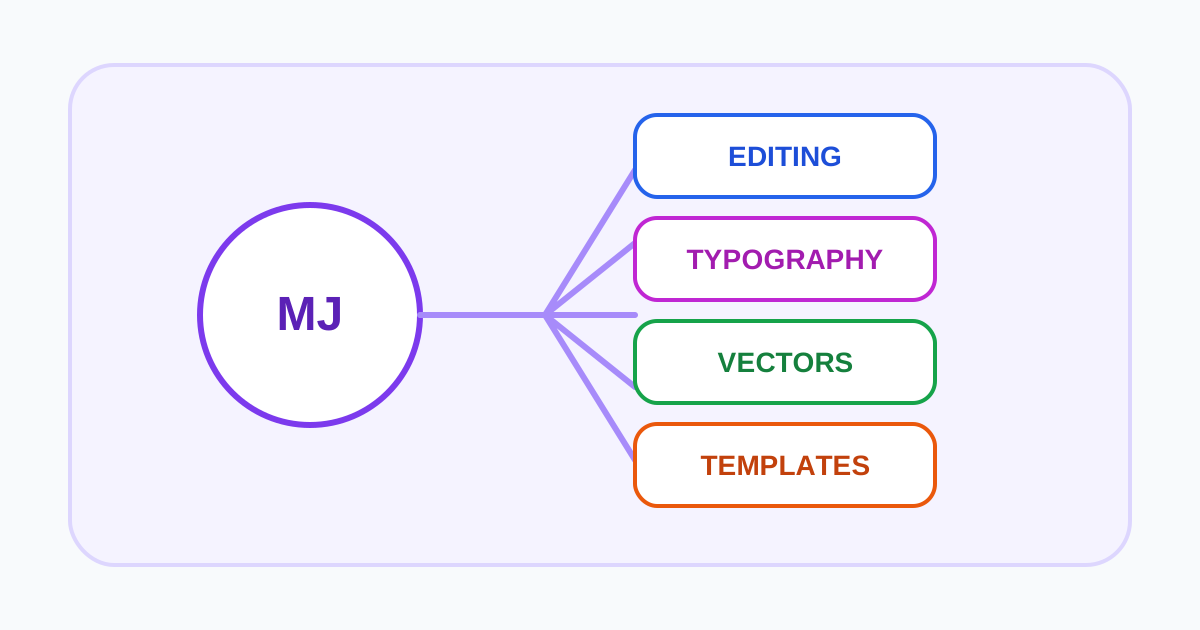
NightCafe's official model guide groups current models by uses such as general quality, value, photorealism, typography, editing, consistent subjects, and video. It notes that approximate base costs change with resolution, output count, references, plan allowances, and other options. The guide also tracks retired models when outside providers discontinue them.
Begin with an inexpensive draft model or setting to validate composition and prompt direction. Move to a higher-cost model only when its specific capability—typography, editing accuracy, consistency, realism, or resolution—matters. Generate a small controlled comparison using the same prompt and aspect ratio. Provider marketing examples use different prompts and selection, so they are not a fair benchmark.
Record the model, version, prompt, negative prompt where supported, seed, references, aspect ratio, resolution, and edit history. If a production asset depends on a third-party model, keep an exported master and a replacement plan. NightCafe's 2026 documentation shows that well-known image and video models can be retired when their provider changes availability.
Review outputs at full size for anatomy, small objects, typography, reflections, texture repetition, lighting, signatures, logos, and subject consistency. Visual fluency is not proof that a historical scene, product, person, chart, or news event is accurate. Use a design or photo editor for exact text and branded elements.
Credits, PRO, and free use
NightCafe uses a layered credit system. Its subscription and credit knowledge base describes recurring PRO plans with credits, one-off packs or top-ups, and credits earned through activities such as creation streaks and badges. PRO subscription credits are added to free earning opportunities rather than replacing them.
Fast Credits come from purchases, subscriptions, top-ups, packs, or gift cards. They skip the slower queue and can be required for expensive models. Relax Credits are earned and use a queued mode with restrictions. Purchased credits are documented as rolling over without expiration, while separate loyalty or promotional rewards may expire.
The useful unit is not “one credit equals one image.” Model, quality, resolution, number of images, references, editing, video, and subscription allowances change consumption. Keep a draft budget and reserve expensive settings for shortlisted concepts. Before buying a plan, test the models actually required because a large credit balance does not guarantee access to every PRO-only feature.
Community visibility and privacy
NightCafe includes social publishing, profiles, challenges, chat, and community rewards. These features can make learning and discovery enjoyable, but users must understand what is private, published, or discoverable. Do not share confidential briefs, client references, personal images, or hidden production details in a public creation or room. NightCafe's chat guidance notes that making a room public can expose earlier messages as well.
The privacy policy describes identity, contact, transaction, technical, profile, interaction, marketing, and user-created data. Profile data can include designs created before deletion and content posted, sent, received, or shared. It also identifies service, analytics, advertising, payment, hosting, Discord, and international-disclosure contexts.
Model providers may add further data paths and terms. Before sensitive use, determine whether prompts and references go only to NightCafe or also to a third-party inference provider, how long creations remain, what deletion covers, and whether a private generation is used for analytics or service improvement. Avoid biometric or identity-sensitive fine-tuning without explicit consent and a policy review.
Ownership and commercial use
NightCafe's commercial-use guidance says users may generally sell or commercially use creations if they did not use copyrighted images without permission, subject to the copyright law of their jurisdiction. Where NightCafe would be treated as the copyright holder, it says it assigns that interest to the creator under those conditions.
That is not universal legal clearance. Users still need rights to start images, style-transfer inputs, reference people, brands, characters, and other protected material. The selected underlying model can have separate restrictions, and some jurisdictions may not recognize copyright in primarily AI-generated work. Preset or free images should also be checked rather than assumed clear.
For commercial work, save input licenses and consent, read the current model and platform terms, search for trademarks or copied elements, and have a human substantially edit important assets. Do not imitate a living artist or use a real person's likeness merely because the interface accepts the prompt.
Alternatives and decision guidance
NightCafe is a good fit for users who value variety and community more than a single stable production model. Compare Midjourney for a focused aesthetic ecosystem, Leonardo AI for creator and asset workflows, Ideogram when typography is central, or Playground AI for general image generation and editing.
Test candidates on the same brief and compare final approval time, credit consumption, reproducibility, rights, data paths, and model continuity. NightCafe's model breadth is an advantage for exploration; production teams should add stricter records and fallback planning.
Visit the official NightCafe website